Invisible Labour Recognizing Unpaid Work and its Impact on Women's Human Rights in India
DOI:
https://doi.org/10.54741/SSJAR/6.3.2026.393Keywords:
invisible labour, unpaid work, women’s empowerment, women’s human rightAbstract
Unpaid domestic labour is a crucial component of productive endeavors and an essential element that supports the economy and well-being of households. Unpaid and frequently unappreciated work, mostly performed by women, that supports households and communities but is not included in economic measurements is referred to as invisible labor. In India, where societal structures are greatly influenced by conventional gender roles, women carry out a large portion of the labor force through caring for others, farming, and household chores.. It draws attention to the ways that the weight of invisible labor impacts women's emotional and physical well-being, limits their educational opportunities, hinders their ability to enter the workforce, and feeds the cycles of inequality and poverty. The study advocates for policies that acknowledge and recompense unpaid labor by using data from a variety of areas, such as household surveys and agriculture. It also promotes changes to labor legislation, social protection programs, and educational initiatives to dispel long-standing prejudices. In addition to having the capacity to change India's economic and social dynamics, addressing invisible labor is crucial for achieving gender equality and women's rights.
Downloads
References
Budlender, Debbie, & Fontana, Marzia. (2010). Unpaid care work and the economy. International Labour Organization.
Chakravarti, Uma. (1993). Conceptualising Brahmanical patriarchy in early India: Gender, caste, class and state. Economic and Political Weekly, 28(14), 579–585.
Chapman, Kathy, & Mishra, Vinod. (2019). Working women in India: Understanding the decline in female labour force participation. World Bank.
Chaudhary, Ruchi, &Verick, Sher. (2014). Female labour force participation in India and beyond. International Labour Organization.
Cooper, Marilyn, Stone, Deborah, & other authors. (2013). [Complete title and publication details required].
Convention on the Elimination of All Forms of Discrimination Against Women, Dec. 18, 1979, 1249 U.N.T.S. 13.
Cott, Nancy F. (1997). The bonds of womanhood: "Woman's sphere" in New England, 1780–1835. (2nd ed.). Yale University Press.
Das, Maitreyi Bordia. (2006). Do traditional axes of exclusion affect labor market outcomes in India?. Social Development Papers No. 97. World Bank.
Desai, Sonalde, & Joshi, Omkar. (2019). The paradox of declining female work participation in an era of economic growth. Indian Journal of Labour Economics, 62(1), 55–71. https://doi.org/10.1007/s41027-019-00162-z
Dube, Leela. (1998). Women and kinship: Comparative perspectives on gender in South and South-East Asia. United Nations University Press.
Dubbert, Joe L. (1979). A man's place: Masculinity in transition. Prentice-Hall.
Elson, Diane. (1999). Labor markets as gendered institutions: Equality, efficiency and empowerment issues. World Development, 27(3), 611–627. https://doi.org/10.1016/S0305-750X(98)00147-8
Eswaran, Mukesh, Ramaswami, Bharat, &Wadhwa, Wilima. (2013). Status, caste, and the time allocation of women in rural India. Economic Development and Cultural Change, 61(2), 311–333. https://doi.org/10.1086/668282
Folbre, Nancy, & Yoon, Jayoung. (2008). Economic development and time devoted to direct unpaid care activities: A gendered analysis. In N. Folbre (Ed.), Valuing children: Rethinking the economics of the family. Harvard University Press.
Gardiner, Jean, Himmelweit, Susan, Mackintosh, Maureen, & Mackintosh, Michèle. (1975). Women's domestic labour. New Left Review, 89, 47–58.
Gilman, Charlotte Perkins. (1998). Women and economics: A study of the economic relation between men and women as a factor in social evolution. Dover Publications. (Original work published 1898)
Ginther, Donna K., & Hayes, Kathy J. (2003). Gender differences in salary and promotion in the humanities. American Economic Review, 93(2), 229–235. https://doi.org/10.1257/000282803321947446
Guarino, Cassandra M., & Borden, Victor M. H. (2017). Faculty service loads and gender: Are women taking care of the academic family?. Research in Higher Education, 58(6), 672–694. https://doi.org/10.1007/s11162-017-9454-2
Hartmann, Heidi I. (1976). Capitalism, patriarchy, and job segregation by sex. Signs, 1(3), 137–169.
Hirway, Indira. (2010). Time-use surveys in developing countries: An assessment. In R. Antonopoulos & I. Hirway (Eds.), Unpaid work and the economy: Gender, time use and poverty in developing countries (pp. 252–324). Palgrave Macmillan.
Hirway, Indira. (2015). Unpaid work and the economy: Linkages and their implications. Indian Journal of Labour Economics, 58(1), 1–21.
International Covenant on Economic, Social and Cultural Rights, Dec. 16, 1966, 993 U.N.T.S. 3.
International Labour Organization. (1981). Convention No. 156: Workers with family responsibilities convention.
International Labour Organization. (2000). Convention No. 183: Maternity protection convention.
International Labour Organization. (2011). Convention No. 189: Domestic workers convention.
Kapsos, Steven, Silberman, Amy, & Bourmpoula, Evangelia. (2014). Why is female labour force participation declining so sharply in India? International Labour Organization.
Kessler-Harris, Alice. (1987). Out to work: A history of wage-earning women in the United States. Oxford University Press.
Kumar, Anil. (2020). Dalit women and the struggle for equality and human rights. [Publisher details required].
Luís, A., et al. (2017). [Title of the specific publication]. [Complete publication details required].
Marphatia, Akanksha A., &Moussié, Rachel. (2013). A question of gender justice: Exploring the links between women's unpaid care work, education, and gender equality. ActionAid.
Matthaei, Julie A. (2001). Beyond economic man: Feminist theory and economics. M.E. Sharpe.
Matthaei, Julie A., &Amott, Teresa L. (1996). Race, gender, and work: A multicultural economic history of women in the United States. South End Press.
Mincer, Jacob. (1962). Labor force participation of married women: A study of labor supply. In H. G. Lewis (Ed.), Aspects of labor economics (pp. 63–105). Princeton University Press.
Ministry of Statistics and Programme Implementation. (2019). Periodic Labour Force Survey (PLFS) 2017–18. Government of India.
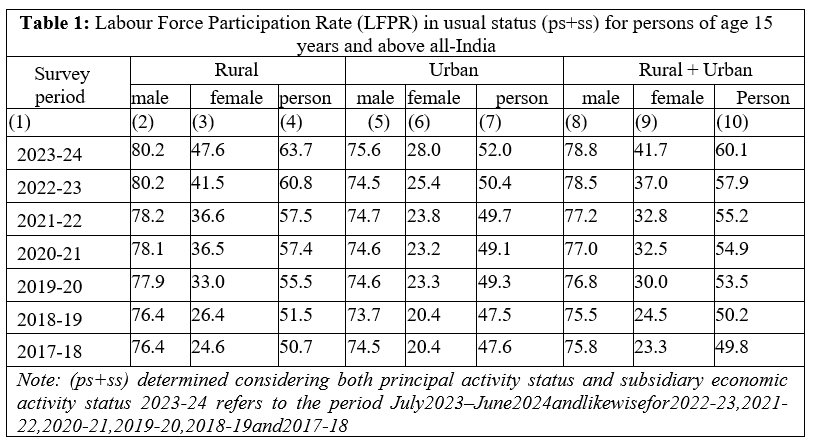
Ministry of Statistics and Programme Implementation. (2024). Periodic Labour Force Survey (PLFS) Annual Report 2023–24. Government of India.
National Statistical Office. (2019). Time use in India, 2019. Ministry of Statistics and Programme Implementation, Government of India.
Neetha, N. (2010). Interrogating caste and gender in the construction of labour markets. Indian Journal of Labour Economics, 53(3), 429–445.
Rao, Anupama. (2010). Dalit women and the politics of exclusion. [Publisher details required].
Samantroy, Ellina. (2022). Recognising unpaid care work in India: Issues and challenges. Economic and Political Weekly, 57(15), 45–52.
Sen, Amartya. (1999). Development as freedom. Oxford University Press.
Singh, P., &Pattanaik, F. (2020). Unfolding unpaid domestic work in India: Women's constraints, choices, and career. Palgrave Macmillan.
Tasnim, S. (2020). [Complete publication details required].
Tripathi, S., &Zhai, F. (2023). Gender inequality in unpaid care work and its implications for women's empowerment. Journal of Social and Economic Development, 25(2), 345–362.
United Nations. (2015). Transforming our world: The 2030 agenda for sustainable development. United Nations Sustainable Development Goals.
Verick, Sher. (2014). Female labor force participation in developing countries. IZA World of Labor, 87, 1–10. https://doi.org/10.15185/izawol.87
Vyas, S. (2022). [Complete publication details required].
Williams, Joan. (2001). Unbending gender: Why family and work conflict and what to do about it. Oxford University Press.
Published
How to Cite
Issue
Section
License
Copyright (c) 2026 Prajitha. V. V, Tessymol George, Dr. N. Karunakaran

This work is licensed under a Creative Commons Attribution 4.0 International License.
Research Articles in 'Social Science Journal for Advanced Research' are Open Access articles published under the Creative Commons CC BY License Creative Commons Attribution 4.0 International License http://creativecommons.org/licenses/by/4.0/. This license allows you to share – copy and redistribute the material in any medium or format. Adapt – remix, transform, and build upon the material for any purpose, even commercially.


