Quick-Commerce and the Future of Small Retail: An Empirical Study of Consumer Shift and Retail Disruption in Delhi NCR
DOI:
https://doi.org/10.54741/SSJAR/6.3.2026.392Keywords:
quick commerce, consumer shift, kirana stores, retail disruption, perceived convenience, disruptive innovation, PLS-SEM, Delhi NCRAbstract
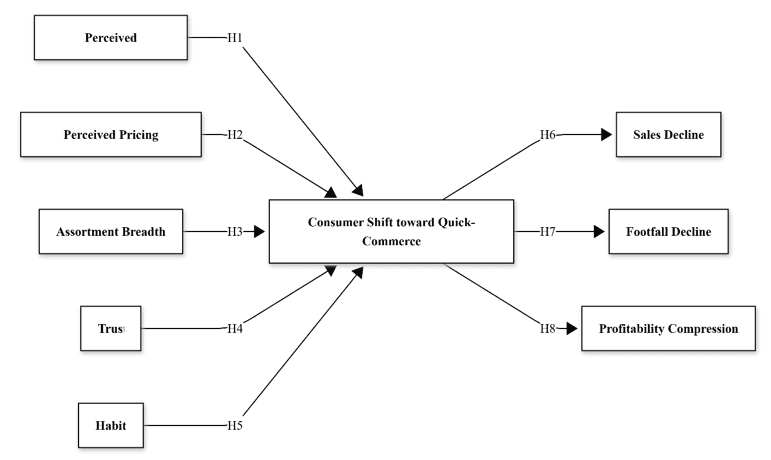
The rise of quick-commerce platforms has significantly reshaped grocery delivery in Indian metros by providing ultra-fast delivery and hyper-competitive prices, sparking concerns over their influence on small retailers. This study aims to explore the impact of quick-commerce on the kirana stores in Delhi NCR, where the shop's disruptions are related to the consumers' shift behavior as the key behavioral mechanism between consumer perceptions and retailer-level outcomes. A cross-sectional dual-respondent design was employed and data were analysed using partial least squares structural equation modeling (PLS-SEM) software package (SmartPLS 4) with sample size of 400 quick commerce users and 300 Kirana store owners. The results indicate that perceived convenience and perceived pricing advantage are the most salient predictors of consumer shift, complemented by trust , and assortment breadth. Consumer shift, in turn, significantly amplifies perceived sales decline, footfall decline , and profitability compression among Kirana retailers. The proposed model accounts for 54% of consumer shift, and 28-36% of disruption outcomes, and is reasonably reliable, valid, and fits the data well. The study contributes to the literature of quick-commerce and retail disruption by incorporating constructs related to technology adoption, trust, and habit along with disruptive innovation outcomes within the context of an emerging market, and provides implications for Kirana retailers, platform companies, and policy makers.
Downloads
References
Anderson, J. C., & Gerbing, D. W. (1988). Structural equation modeling in practice: A review and recommended two-step approach. Psychological Bulletin, 103(3), 411–423. https://doi.org/10.1037/0033-2909.103.3.411
Bagozzi, R. P., & Yi, Y. (1988). On the evaluation of structural equation models. Journal of the Academy of Marketing Science, 16(1), 74–94. https://doi.org/10.1007/BF02723327
Baker, J., Parasuraman, A., Grewal, D., & Voss, G. B. (2002). The influence of multiple store environment cues on perceived merchandise value and patronage intentions. Journal of Marketing, 66(2), 120–141. https://doi.org/10.1509/jmkg.66.2.120.18470
Baruch, Y., & Holtom, B. C. (2008). Survey response rate levels and trends in organizational research. Human Relations, 61(8), 1139–1160. https://doi.org/10.1177/0018726708094863
Bell, D. R., Ho, T.-H., & Tang, C. S. (1998). Determining where to shop: Fixed and variable costs of shopping. Journal of Marketing Research, 35(3), 352–369. https://doi.org/10.1177/002224379803500306
Bhatia, A., & Sharma, P. (2024). Quick commerce in India: The next retail revolution. Journal of Retailing and Consumer Services, 78, Article 103712. https://doi.org/10.1016/j.jretconser.2024.103712
Bhatnagar, A., Ghose, S., & Sinha, P. (2023). Understanding platform-based retail disruption in emerging markets. International Journal of Retail & Distribution Management, 51(9/10), 1125–1144. https://doi.org/10.1108/IJRDM-01-2023-0012
Boston Consulting Group. (2023). The future of kirana stores in India: Adapting to digital disruption. BCG.
Brady, M. K., & Cronin, J. J., Jr. (2001). Some new thoughts on conceptualizing perceived service quality: A hierarchical approach. Journal of Marketing, 65(3), 34–49. https://doi.org/10.1509/jmkg.65.3.34.18334
Broniarczyk, S. M., & Hoyer, W. D. (2006). Retail assortment: More ≠ better. In M. Krafft & M. K. Mantrala (Eds.), Retailing in the 21st century: Current and future trends (pp. 225–238). Springer.
Brynjolfsson, E., & Smith, M. D. (2000). Frictionless commerce? A comparison of Internet and conventional retailers. Management Science, 46(4), 563–585. https://doi.org/10.1287/mnsc.46.4.563.12061
Christensen, C. M. (1997). The innovator’s dilemma: When new technologies cause great firms to fail. Harvard Business School Press.
Christensen, C. M., & Raynor, M. E. (2003). The innovator’s solution: Creating and sustaining successful growth. Harvard Business School Press.
Churchill, G. A., Jr. (1979). A paradigm for developing better measures of marketing constructs. Journal of Marketing Research, 16(1), 64–73. https://doi.org/10.1177/002224377901600110
Dabholkar, P. A., Thorpe, D. I., & Rentz, J. O. (1996). A measure of service quality for retail stores: Scale development and validation. Journal of the Academy of Marketing Science, 24(1), 3–16. https://doi.org/10.1177/009207039602400101
Davis, F. D. (1989). Perceived usefulness, perceived ease of use, and user acceptance of information technology. MIS Quarterly, 13(3), 319–340. https://doi.org/10.2307/249008
Deloitte. (2024). Quick commerce: Redefining speed and convenience in Indian retail. Deloitte India.
DeVellis, R. F. (2017). Scale development: Theory and applications (4th ed.). Sage Publications.
Dholakia, R. R., Dholakia, N., & Chattopadhyay, A. (2020). India’s retail revolution: The rise of modern trade and the future of kirana stores. Journal of Macromarketing, 40(4), 456–472. https://doi.org/10.1177/0276146720949638
Federation of Retailers Association of India. (2025). Future of retail in Asia 2025: The quick commerce disruption. FRAI.
Fornell, C., & Larcker, D. F. (1981). Evaluating structural equation models with unobservable variables and measurement error. Journal of Marketing Research, 18(1), 39–50. https://doi.org/10.1177/002224378101800104
Forman, C., Ghose, A., & Goldfarb, A. (2009). Competition between local and electronic markets: The implications of consumer search. Journal of Marketing Research, 46(3), 409–423. https://doi.org/10.1509/jmkr.46.3.409
Gauri, D. K., Grewal, D., & Roggeveen, A. L. (2021). Understanding retail competition and its implications. Journal of Retailing, 97(1), 1–8. https://doi.org/10.1016/j.jretai.2021.01.001
Gefen, D., Karahanna, E., & Straub, D. W. (2003). Trust and TAM in online shopping: An integrated model. MIS Quarterly, 27(1), 51–90. https://doi.org/10.2307/30036519
Gefen, D., & Straub, D. (2000). The relative importance of perceived ease of use in IS adoption: A study of e-commerce adoption. Journal of the Association for Information Systems, 1(8), 1–30. https://doi.org/10.17705/1jais.00008
Grewal, D., Roggeveen, A. L., & Nordfält, J. (2020). The future of retailing. Journal of Retailing, 96(1), 1–6. https://doi.org/10.1016/j.jretai.2019.12.002
Gupta, S., & Duggal, S. (2024). Trust and loyalty in quick commerce platforms: An Indian perspective. Journal of Consumer Behaviour, 23(2), 678–695. https://doi.org/10.1002/cb.2321
Gupta, S., & Kim, H.-W. (2010). Value-driven internet shopping: The mental accounting theory perspective. Psychology & Marketing, 27(1), 13–35. https://doi.org/10.1002/mar.20317
Hair, J. F., Jr., Hult, G. T. M., Ringle, C. M., & Sarstedt, M. (2019). A primer on partial least squares structural equation modeling (PLS-SEM) (2nd ed.). Sage Publications.
Hair, J. F., Jr., Hult, G. T. M., Ringle, C. M., & Sarstedt, M. (2022). A primer on partial least squares structural equation modeling (PLS-SEM) (3rd ed.). Sage Publications.
Henseler, J., Ringle, C. M., & Sarstedt, M. (2015). A new criterion for assessing discriminant validity in variance-based structural equation modeling. Journal of the Academy of Marketing Science, 43(1), 115–135. https://doi.org/10.1007/s11747-014-0403-8
Hoch, S. J., Bradlow, E. T., & Wansink, B. (1999). The variety of an assortment. Marketing Science, 18(4), 527–546. https://doi.org/10.1287/mksc.18.4.527
Hu, L., & Bentler, P. M. (1999). Cutoff criteria for fit indexes in covariance structure analysis: Conventional criteria versus new alternatives. Structural Equation Modeling, 6(1), 1–55. https://doi.org/10.1080/10705519909540118
Inman, J. J., & Nikolova, H. (2017). Shopper-facing retail technology: A retailer adoption decision framework incorporating shopper attitudes and privacy concerns. Journal of Retailing, 93(1), 7–28. https://doi.org/10.1016/j.jretai.2016.12.003
Inman, J. J., Winer, R. S., & Ferraro, R. (2009). The interplay among category characteristics, customer characteristics, and customer activities on in-store decision making. Journal of Marketing, 73(5), 19–29. https://doi.org/10.1509/jmkg.73.5.19
Invest India. (2024). India’s quick commerce market outlook 2024–2028. https://www.investindia.gov.in
Jasperson, J. S., Carter, P. E., & Zmud, R. W. (2005). A comprehensive conceptualization of post-adoptive behaviors associated with information technology enabled work systems. MIS Quarterly, 29(3), 525–557. https://doi.org/10.2307/25148694
Kim, S. S., & Malhotra, N. K. (2005). A longitudinal model of continued IS use: An integrative view of four mechanisms underlying postadoption phenomena. Management Science, 51(5), 741–755. https://doi.org/10.1287/mnsc.1040.0326
Kline, R. B. (2016). Principles and practice of structural equation modelling. (4th ed.). Guilford Press.
Kock, N. (2015). Common method bias in PLS-SEM: A full collinearity assessment approach. International Journal of e-Collaboration, 11(4), 1–10. https://doi.org/10.4018/ijec.2015100101
Kumar, V., & Singh, R. (2024). Platformization and the future of traditional retail in India. Journal of Business Research, 168, Article 114215. https://doi.org/10.1016/j.jbusres.2023.114215
Lankton, N. K., Wilson, E. V., & Mao, E. (2010). Antecedents and determinants of information technology habit. Information & Management, 47(5–6), 300–307. https://doi.org/10.1016/j.im.2010.06.004
Limayem, M., & Cheung, C. M. K. (2008). Understanding information systems continuance: The case of Internet-based learning technologies. Information & Management, 45(4), 227–232. https://doi.org/10.1016/j.im.2008.02.005
McKnight, D. H., Choudhury, V., & Kacmar, C. (2002). Developing and validating trust measures for e-commerce: An integrative typology. Information Systems Research, 13(3), 334–359. https://doi.org/10.1287/isre.13.3.334.81
Mehta, R., & Kumar, A. (2024). Quick commerce and its impact on traditional retail: Evidence from Indian cities. International Journal of Retail & Distribution Management, 52(1), 45–62. https://doi.org/10.1108/IJRDM-05-2023-0284
Mellahi, K., & Harris, L. C. (2016). Response rates in business and management research: An overview of current practice and suggestions for future direction. British Journal of Management, 27(2), 426–437. https://doi.org/10.1111/1467-8551.12154
Nielsen. (2022). The evolving Indian shopper: Kirana vs. modern trade. NielsenIQ.
Ouellette, J. A., & Wood, W. (1998). Habit and intention in everyday life: The multiple processes by which past behavior predicts future behavior. Psychological Bulletin, 124(1), 54–74. https://doi.org/10.1037/0033-2909.124.1.54
Pan, Y., & Zinkhan, G. M. (2006). Determinants of retail patronage: A meta-analytical perspective. Journal of Retailing, 82(3), 229–243. https://doi.org/10.1016/j.jretai.2005.11.008
Parasuraman, A., Zeithaml, V. A., & Berry, L. L. (1988). SERVQUAL: A multiple-item scale for measuring consumer perceptions of service quality. Journal of Retailing, 64(1), 12–40.
Pavlou, P. A. (2003). Consumer acceptance of electronic commerce: Integrating trust and risk with the technology acceptance model. International Journal of Electronic Commerce, 7(3), 101–134. https://doi.org/10.1080/10864415.2003.11044275
Podsakoff, P. M., MacKenzie, S. B., & Podsakoff, N. P. (2012). Sources of method bias in social science research and recommendations on how to control it. Annual Review of Psychology, 63, 539–569. https://doi.org/10.1146/annurev-psych-120710-100452
PricewaterhouseCoopers. (2024). India’s quick commerce boom: Impact on traditional retail. PwC India.
Rao, S., & Varshney, S. (2023). Hyperlocal delivery platforms: The Indian story. Business Horizons, 66(5), 623–636. https://doi.org/10.1016/j.bushor.2023.02.005
Redseer Strategy Consultants. (2024). Quick commerce in India: Market sizing and growth forecast 2024–2028. Redseer.
Rindfleisch, A., Malter, A. J., Ganesan, S., & Moorman, C. (2008). Cross-sectional versus longitudinal survey research: Concepts, findings, and guidelines. Journal of Marketing Research, 45(3), 261–279. https://doi.org/10.1509/jmkr.45.3.261
Ringle, C. M., Sarstedt, M., Sinkovics, R. R., & Sinkovics, N. (2022). Partial least squares structural equation modeling (PLS-SEM) using R: A workbook. Springer. https://doi.org/10.1007/978-3-030-80519-7
Sarstedt, M., Hair, J. F., Jr., & Ringle, C. M. (2022). PLS-SEM: Foundations and recent methods. Springer.
Sharma, P., & Gupta, S. (2023). Consumer adoption of quick commerce: An extended UTAUT2 perspective. Journal of Retailing and Consumer Services, 72, Article 103256. https://doi.org/10.1016/j.jretconser.2023.103256
Sharma, S., & Sharma, R. (2023). Trust in on-demand grocery delivery: Role of perceived risk and platform reputation. International Journal of Consumer Studies, 47(4), 1452–1468. https://doi.org/10.1111/ijcs.12912
Shmueli, G., Ray, S., Estrada, J. M. V., & Chatla, S. B. (2019). The elephant in the room: Predictive performance of PLS-SEM models. Journal of Business Research, 98, 277–295. https://doi.org/10.1016/j.jbusres.2019.01.057
Sinha, P. K., & Banerjee, A. (2021). Kirana stores in India: Survival and growth in the digital age. Sage Publications.
Tellis, G. J. (2006). Disruptive technology or visionary leadership? Journal of Product Innovation Management, 23(1), 34–38. https://doi.org/10.1111/j.1540-5885.2005.00179.x
Venkatesh, V., & Davis, F. D. (2000). A theoretical extension of the technology acceptance model: Four longitudinal field studies. Management Science, 46(2), 186–204. https://doi.org/10.1287/mnsc.46.2.186.11926
Venkatesh, V., Morris, M. G., Davis, G. B., & Davis, F. D. (2003). User acceptance of information technology: Toward a unified view. MIS Quarterly, 27(3), 425–478. https://doi.org/10.2307/30036540
Verhoef, P. C., Kannan, P. K., & Inman, J. J. (2015). From multi-channel retailing to omni-channel retailing. Journal of Retailing, 91(2), 174–181. https://doi.org/10.1016/j.jretai.2015.02.005
Verplanken, B., & Orbell, S. (2003). Reflections on past behavior: A self-report index of habit strength. Journal of Applied Social Psychology, 33(6), 1313–1330. https://doi.org/10.1111/j.1559-1816.2003.tb01951.x
Williams, M. D., Rana, N. P., & Dwivedi, Y. K. (2015). The unified theory of acceptance and use of technology (UTAUT): A literature review. Journal of Enterprise Information Management, 28(3), 443–488. https://doi.org/10.1108/JEIM-06-2014-0068
Zeithaml, V. A. (1988). Consumer perceptions of price, quality, and value: A means-end model and synthesis of evidence. Journal of Marketing, 52(3), 2–22. https://doi.org/10.1177/002224298805200302
Published
How to Cite
Issue
Section
License
Copyright (c) 2026 Dr. Mansi Bansal

This work is licensed under a Creative Commons Attribution 4.0 International License.
Research Articles in 'Social Science Journal for Advanced Research' are Open Access articles published under the Creative Commons CC BY License Creative Commons Attribution 4.0 International License http://creativecommons.org/licenses/by/4.0/. This license allows you to share – copy and redistribute the material in any medium or format. Adapt – remix, transform, and build upon the material for any purpose, even commercially.


