India’s Competitiveness in Digitally Delivered Services Trade: A Comparative Analysis with Global Peers
DOI:
https://doi.org/10.54741/SSJAR/6.3.2026.382Keywords:
digitally delivered services (DDS), trade competitiveness, revealed comparative advantage (RCA), market shareAbstract
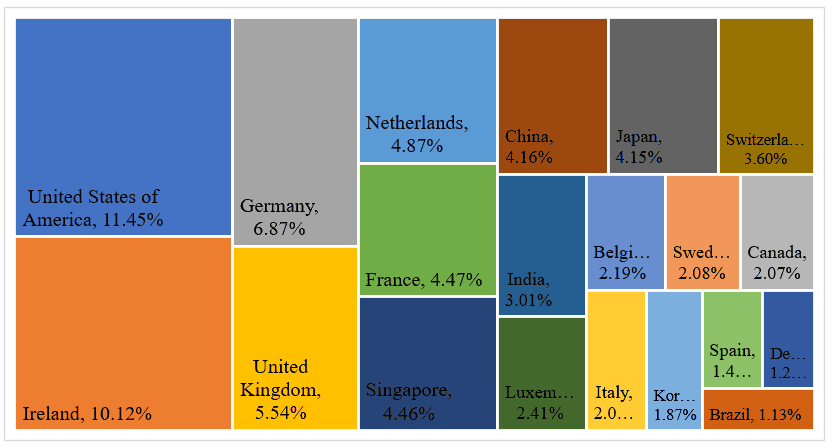
Digitalisation is transforming the world and has significantly changed the international trade landscape. The share of digitally delivered services (DDS) in trade has increased significantly over the last two decades. This paper aims to analyse India's comparative status in the DDS trade and its competitiveness in the international market. The competitiveness of India's DDS exports is assessed using various indices, such as Revealed Comparative Advantage, Revealed Symmetric Comparative Advantage, International Market Share, Market Share Growth, and Trade Competitiveness Index, and compared with the top 20 DDS exporters worldwide from 2005 to 2024. The paper highlights that India’s market share in DDS exports is the fifth largest and has doubled over the past two decades. While India possesses strong competitiveness in this sector, it has experienced a decline in its standing over time. The USA, UK, Ireland, and Germany hold a larger market share, while countries like Luxembourg, Poland, Sweden, the Netherlands, and Spain are showcasing higher growth in their market share compared to India. They are the major competitors of India in DDS exports. India must diversify its export basket and actively seek global partnerships and alliances with other nations to enhance its competitiveness in the global DDS market.
Downloads
References
Balassa, B. (1965). Trade liberalisation and “revealed” comparative advantage 1. The Manchester School, 33(2), 99-123. https://doi.org/10.1111/j.1467-9957.1965.tb00050.x
International Data Center Authority. (2025). Global Digital Economy Report, 6. https://www.idc-a.org/download?source=Global%20Digital%20Economy%20Report%20(2025)&insight=qUi9XgvyrzSkyDUy9Tqr
Narayanan, K. & Sengupta, D. (2025). India’s path to global leadership: Strategic imperatives for Viksit Bharat @ 2047 [Working Paper]. NITI Aayog, 7. https://www.niti.gov.in/sites/default/files/2025-04/Working%20Paper%20on%20Strategic%20Imperatives_04042025_NEW.pdf
Li, J. & Wang, F. (2024). A study on the competitiveness and influencing factors of the digital service trade. Sustainability, 16, 3116, 7-9. https://doi.org/10.3390/su16083116
Feng, Z. & Zhang, M-M. (2022). Comparison of the international competitiveness of digital services trade between Korea and China. Journal of Korea Trade, 26(3), 79-101. https://doi.org/10.35611/jkt.2022.26.3.79
United Nations Conference on Trade and Development (UNCTAD). (n.d.). Data insights. Retrieved on 15 April 2026 from https://unctadstat.unctad.org/insights/theme/254
Ferencz, J. (2019). The OECD digital services trade restrictiveness index (OECD trade policy papers no. 221). OECD Publishing. http://dx.doi.org/10.1787/16ed2d78-en
World Trade Organisation (WTO). Digitally Delivered Services Trade Dataset (2005-2024). https://data.wto.org/en/dataset/dideliveredservices
Sun, Q. (2024). Analysis of the competitiveness of digital service trade between China and RCEP partner countries. Advances in Economics, Management and Political Sciences, 122(1). https://doi.org/10.54254/2754-1169/122/20242579
Published
How to Cite
Issue
Section
License
Copyright (c) 2026 Dr. Neha Paliwal

This work is licensed under a Creative Commons Attribution 4.0 International License.
Research Articles in 'Social Science Journal for Advanced Research' are Open Access articles published under the Creative Commons CC BY License Creative Commons Attribution 4.0 International License http://creativecommons.org/licenses/by/4.0/. This license allows you to share – copy and redistribute the material in any medium or format. Adapt – remix, transform, and build upon the material for any purpose, even commercially.


