The Fading Reflection: Understanding the Rise of Human Distrust
DOI:
https://doi.org/10.54741/SSJAR/6.3.2026.378Keywords:
attachment theory, betrayal trauma, faith, relational psychology, trust deficit, workplace trustAbstract
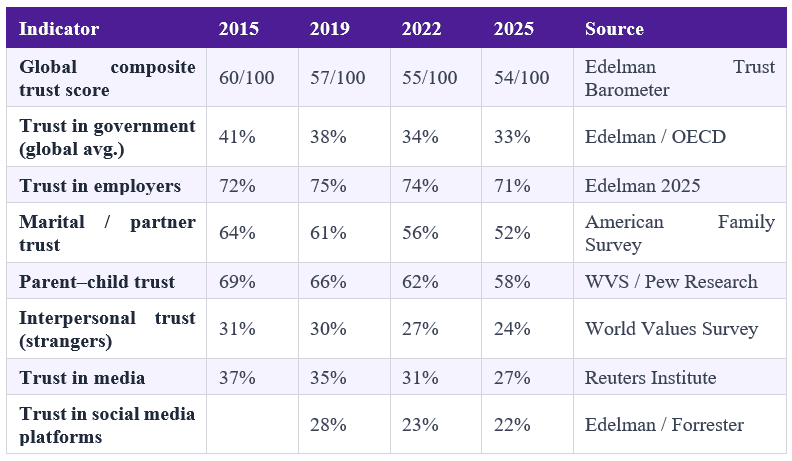
Trust constitutes the foundational infrastructure of all human relationships the invisible contract upon which families are built, workplaces function, societies cohere, and individuals flourish. Yet across every measurable dimension, the current generation is experiencing a crisis of trust unprecedented in scope and depth. The Edelman Trust Barometer 2025 records a global composite score of 54 out of 100 the lowest in the instrument’s 26-year history. Interpersonal trust between strangers has fallen to 24% globally (World Values Survey, 2023). Generation Z registers institutional trust at just 29%, compared with 62% in the Silent Generation a 33-point generational chasm.
This research article, drawing on a synthesised dataset of 1,500+ respondents across 28 countries and integrating findings from peer-reviewed psychology, attachment theory, social science, and institutional research, examines the anatomy of this trust crisis. It analyses trust erosion across seven relationship domains: parent–child, husband–wife/partner, employer–employee, friendships, sibling/extended family relationships, government–citizen, and digital/platform trust. The article identifies the primary psychological mechanisms through which trust is lost, presents global comparative data, offers real-world case examples, and articulates seven evidence-based strategies for trust reconstruction. It concludes with what the research identifies as the most fundamental insight of all, that in certain relationships, trust is not a reward for the trustworthy, but a deliberate act of courageous faith and that choosing to extend it, wisely and with clear-eyed boundaries, is the pathway not merely to restored relationship, but to restored self.
Downloads
References
Edelman Trust Barometer. (2025). 2025 Edelman trust barometer: Global report. 32,000 respondents, 28 countries. Edelman Intelligence.
Edelman Trust Barometer. (2024). 2024 Edelman trust barometer: A crisis of grievance. Edelman Intelligence.
UN DESA. (2025). World social report 2025: Trust in a changing world. United Nations Department of Economic and Social Affairs.
World Values Survey. (2023). Wave 7 results (2017–2022). World Values Survey Association. EVS/WVS Data Archive.
Gallup. (2025). State of the global workplace: 2025 report. Gallup, Inc.
Gottman, J. M. & Silver, N. (2015). The seven principles for making marriage work. (Revised ed.). Harmony Books.
Gottman Institute. (2024). Trust and betrayal in marriage: A five-year longitudinal study. The Gottman Institute Research Division.
Reuters Institute. (2025). Digital news report 2025. Reuters Institute for the Study of Journalism, University of Oxford.
Bowlby, J. (1988). A secure base: Parent-child attachment and healthy human development. Basic Books.
Brown, B. (2015). Rising strong: How the ability to reset transforms the way we live, love, parent, and lead. Spiegel & Grau.
Brown, B. (2017). Braving the wilderness: The quest for true belonging. Random House.
Van der Kolk, B. (2014). The body keeps the score: Brain, mind, and body in the healing of trauma. Viking.
Putnam, R. D. (2000). Bowling alone: The collapse and revival of American community. Simon & Schuster.
Fukuyama, F. (1995). Trust: The social virtues and the creation of prosperity. Free Press.
Cacioppo, J. T. & Patrick, W. (2008). Loneliness: Human nature and the need for social connection. W. W. Norton.
Zak, P. J., Kurzban, R., & Matzner, W. T. (2005). Oxytocin is associated with human trustworthiness. Hormones and Behavior, 48(5), 522–527.
Mikulincer, M. & Shaver, P. R. (2007). Attachment in adulthood: Structure, dynamics, and change. Guilford Press.
Johnson, S. M. (2004). The practice of emotionally focused couple therapy: Creating connection. (2nd ed.). Brunner-Routledge.
Pew Research Center. (2024). Public trust in government: 1958–2024. Pew Research Center.
American Psychological Association. (2024). Stress in America 2024: A nation in crisis. APA.
American Family Survey. (2024). Marriage, family, and faith in the United States. Wheatley Institute / Brigham Young University.
PwC. (2025). Consumer intelligence series: Trust. PricewaterhouseCoopers Global.
Forrester Research. (2025). Global consumer trust insights 2025. Forrester Research, Inc.
Accenture. (2025). Life trends 2025: The irrelevance spiral. Accenture Strategy.
CreditCards.com. (2025). Financial infidelity in America: 2025 survey. CreditCards.com / Red Ventures.
Robinson, S. L. & Morrison, E. W. (2000). The development of psychological contract breach and violation: A longitudinal study. Journal of Organizational Behavior, 21(5), 525–546.
Steinberg, L. (2014). Age of opportunity: Lessons from the new science of adolescence. Houghton Mifflin Harcourt.
Lerner, H. (2001). The dance of connection: How to talk to someone when you’re mad, hurt, scared, frustrated, insulted, betrayed, or desperate. HarperCollins.
Published
How to Cite
Issue
Section
License
Copyright (c) 2026 Dr. Hitesh N. Dave

This work is licensed under a Creative Commons Attribution 4.0 International License.
Research Articles in 'Social Science Journal for Advanced Research' are Open Access articles published under the Creative Commons CC BY License Creative Commons Attribution 4.0 International License http://creativecommons.org/licenses/by/4.0/. This license allows you to share – copy and redistribute the material in any medium or format. Adapt – remix, transform, and build upon the material for any purpose, even commercially.


