Impact-Based Prioritization and the 0-10 Rule: A Randomized Controlled Study of Productivity Gains and Burnout Reduction in Working Professionals
DOI:
https://doi.org/10.54741/SSJAR/6.3.2026.373Keywords:
productivity, burnout, decision fatigue, goal achievement, occupational wellbeing, 0-10 ruleAbstract
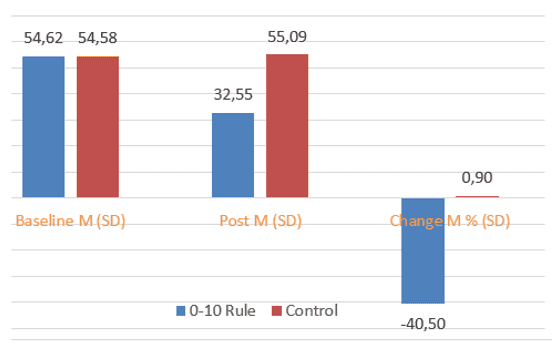
Decision overload, the proliferation of tasks, and persistent time constraints put increasing pressure on modern professions. Rising rates of occupational burnout and decreasing productivity are caused by these factors. Every job, opportunity, or choice is given a numerical score between 0 and 10 according to its possible impact and compatibility with the person's top priorities in the structured prioritization process known as the 0-10 Rule. Tasks with a score of 10 or above are given immediate attention and resources, while those with a lower score are assigned, postponed, or eliminated. This strategy has been supported by anecdotal evidence, but no controlled study has assessed its impact on quantifiable productivity outcomes or burnout. One thousand working professionals (mean age 42.9 years; range 24-62) participated in a 12-week randomized controlled experiment. Participants were split into two groups at random: a passive control group (n = 500) that followed regular work procedures, or an active intervention group (n = 500) that used the 0-10 Rule technique. The main results were burnout (measured using a validated 0-100 burnout scale) and goal progress (operationalized as the Goal Progress Multiplier, a ratio of post-intervention to baseline weekly goal attainment rate). Stress level, job satisfaction, and daily concentrated working hours were secondary results. With a mean Goal Progress Multiplier of 9.83 (SD=0.50), the intervention group's weekly goal attainment was roughly ten times higher than baseline. The multiplier for the control group was 1.04 (SD=0.11). The intervention group's burnout scores decreased by 40.5% (SD=7.34) from a baseline mean of 54.62 (SD=9.57) to a post-intervention mean of 32.55 (SD=7.03). The burnout score for the control group remained constant (+0.9%, SD=7.93). Comparing the treated group to the controls, all secondary outcomes showed a significant improvement. The 0-10 Rule significantly and consistently reduced burnout and increased professional productivity across a wide range of working individuals. The approach is a low-cost, scalable solution that has significant effects on employee wellbeing and organizational performance.
Downloads
References
Alammar, M., & Ram, D. (2025). A review of studies on burnout among doctors in Saudi Arabia. Behavioral Psychology, 33(3), 42895. https://doi.org/10.31083/BP42895
Bailey, C., & Bhagat, R. S. (1987). Meaning and measurement of stressors in the work environment: An evaluation. In S. V. Kasl & C. L. Cooper (Eds.). Stress and health: Issues in research methodology (pp. 207-229). Wiley.
Baumeister, R. F., Vohs, K. D., & Tice, D. M. (2007). The strength model of self-control. Current Directions in Psychological Science, 16(6), 351-355. https://doi.org/10.1111/j.1467-8721.2007.00534.x
Bes, I., Shoman, Y., Al-Gobari, M., & Rousson, V. (2023). Organizational interventions and occupational burnout: a meta-analysis with focus on exhaustion. International Archives of Occupational and Environmental Health, 96(9), 1-13. https://doi.org/10.1007/s00420-023-02009-z?urlappend=%3Futm_source%3Dresearchgate.net%26utm_medium%3Darticle
Bhagat, V., Haque, M., & Simbak, N. (2019). Burnout flattens the professional work productivity. Journal of Datta Meghe Institute of Medical Sciences University, 13(4), 217. https://doi.org/10.4103/jdmimsu.jdmimsu_33_18
Cohen, C., Pignata, S., Bezak, E., Tie, M., Childs, J. (2023). Workplace interventions to improve well-being and reduce burnout for nurses, physicians and allied healthcare professionals: A systematic review. BMJ Open, 13(6), e071203. https://doi.org/10.1136/bmjopen-2022-071203
Conceoção, A., & Palma-Moreira, A. (2025). The relationship between occupational stress, burnout, and perceived performance: The moderating role of work regime. Administrative Sciences, 15(10), 377. https://doi.org/10.3390/admsci15100377?urlappend=%3Futm_source%3Dresearchgate.net%26utm_medium%3Darticle
Corbeanu, A., Illiescu, D., Ion, A., Spinu, R. (2023). The link between burnout and job performance: A meta-analysis. European Journal of Work and Organizational Psychology, 32(1), 1-18. https://doi.org/10.1080/1359432X.2023.2209320
Deci, E. L., & Ryan, R. M. (2000). The 'what' and 'why' of goal pursuits: Human needs and the self-determination of behavior. Psychological Inquiry, 11(4), 227-268. https://doi.org/10.1207/S15327965PLI1104_01
Guseva Canu, I., Marca, S.C., Dell'Oro, F., Balázs, Á., Bergamaschi, E., Besse, C., Bianchi, R., Bislimovska, J., Koscec Bjelajac, A., Bugge, M., Busneag, C.I., Çağlayan, Ç., Cernițanu, M., Costa Pereira, C., Dernovšček Hafner, N., Droz, N., Eglite, M., Godderis, L., Gündel H., Hakanen, J.J., Iordache, R.M., Khireddine-Medouni, I., Kiran, S., Larese-Filon, F., Lazor-Blanchet, C., Légeron, P., Loney, T., Majery, N., Merisalu, E., Mehlum, I.S., Michaud, L., Mijakoski, D., Minov, J., Modenese, A., Molan, M., van der Molen, H., Nena, E., Nolimal, D., Otelea, M., Pletea, E., Pranjic, N., Rebergen, D., Reste, J., Schernhammer, E., Wahlen, A. (2021). Harmonized definition of occupational burnout: A systematic review, semantic analysis, and Delphi consensus in 29 countries. Scandinavian Journal of Work, Environment and Health, 47(2), 95-107. https://doi.org/10.5271/sjweh.3935
Hagger, M. S., Wood, C., Stiff, C., & Chatzisarantis, N. L. D. (2010). Ego depletion and the strength model of self-control: A meta-analysis. Psychological Bulletin, 136(4), 495-525. https://doi.org/10.1037/a0019486
Kahneman, D. (2011). Thinking, fast and slow. Farrar, Straus and Giroux.
Karakitsiou, G., Plakias, S., Tsiakiri, A., & Kedraka, K. (2025). When work moves home: Remote work, occupational stress, mental health, burnout and employee well-being: Trends and strategic roadmap. Psychology International, 7(4), 96. https://doi.org/10.3390/psycholint7040096
Leclercq, C., & Hansez, I. (2024). Temporal stages of burnout: How to design prevention?. International Journal of Environmental Research and Public Health, 21(12), 1617. https://doi.org/10.3390/ijerph21121617
Leroy, S. (2009). Why is it so hard to do my work? The challenge of attention residue when switching between work tasks. Organizational Behavior and Human Decision Processes, 109(2), 168-181. https://doi.org/10.1016/j.obhdp.2009.04.002
Locke, E. A., & Latham, G. P. (2002). Building a practically useful theory of goal setting and task motivation: A 35-year odyssey. American Psychologist, 57(9), 705-717. https://doi.org/10.1037/0003-066X.57.9.705?urlappend=%3Futm_source%3Dresearchgate.net%26utm_medium%3Darticle
Mark, G., Gudith, D., & Klocke, U. (2008). The cost of interrupted work: More speed and stress. in Proceedings of the SIGCHI Conference on Human Factors in Computing Systems, pp. 107-110. https://doi.org/10.1145/1357054.1357072
Maslach, C., & Leiter, M. P. (2016). Understanding the burnout experience: Recent research and its implications for psychiatry. World Psychiatry, 15(2), 103-111. https://doi.org/10.1002/wps.20311
Melhem, S. (2023). The impact of task prioritization on employees’ performance. [MBA Thesis]. Altınbaş University. https://www.researchgate.net/publication/372447665_THE_IMPACT_OF_TASK_PRIORITIZATION_ON_EMPLOYEES'_PERFORMANCE
Pladdys, J. (2024). Mitigating workplace burnout through transformational leadership and employee participation in recovery experiences. HCA Healthcare Journal of Medicine, 5(3), 215-223. https://doi.org/10.36518/2689-0216.1783
Saud, J., & Rice, J. (2024). Stress, teamwork, and wellbeing policies: A synergistic approach to reducing burnout in public sector organizations. Administrative Sciences, 14(12), 319. https://doi.org/10.3390/admsci14120319
Tang, Y.-L., Raffone, A., & Shan Wong, S. (2025). Burnout and stress: new insights and interventions. Scientific Reports, 15, 8335. https://doi.org/10.1038/s41598-025-92909-6
Whelan, E., O’Brien, A., & McCarthy, A (2026). Burnout in hybrid work arrangements: unpacking the role of technostress, psychological detachment, and organisational supports. Internet Research, 36(7), 63–81. https://doi.org/10.1108/INTR-01-2025-0041
Published
How to Cite
Issue
Section
License
Copyright (c) 2026 Michelle Rozen

This work is licensed under a Creative Commons Attribution 4.0 International License.
Research Articles in 'Social Science Journal for Advanced Research' are Open Access articles published under the Creative Commons CC BY License Creative Commons Attribution 4.0 International License http://creativecommons.org/licenses/by/4.0/. This license allows you to share – copy and redistribute the material in any medium or format. Adapt – remix, transform, and build upon the material for any purpose, even commercially.


