Health Issues of Women Handloom Weavers in Manipur
DOI:
https://doi.org/10.54741/SSJAR/6.3.2026.369Keywords:
handloom industry, manipur, women weavers, health issues, incomeAbstract
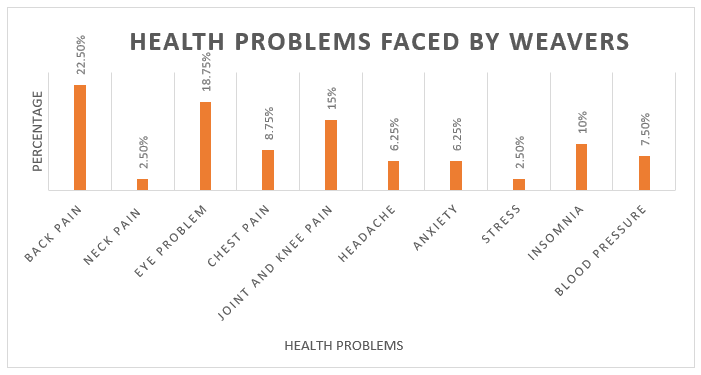
India’s Northeast region, comprising of eight states, is one of the dominant players in the production of handloom products in the country. The state of Manipur is not an exception. It is known for its extensive woven handloom products, which have been an essential determinant in fostering the expansion of the state's growth and development. The handloom industry, next to agriculture, is a vital sector in the state economy and it serves as an important source of livelihood. It also offers job possibilities to a large segment of the local population and also contributes to the maintenance of a stable socioeconomic live for many. The industry has the potential to export varieties of traditional handloom products outside the state, which will help boost the economy. Traditionally, in Manipur, women both young and adults have had significant participation in this industry. The women weavers have distinctive skills and qualities passed on from their ancestors. Most of them belong to rural areas with low socioeconomic status. Limited income has greatly barred them from accessing to quality healthcare facilities. Additionally, poor socioeconomic conditions have compelled them to work in challenging environments such as long hours of work and a lack of proper lighting, which can contribute to adverse health outcomes. The present study aims to identify the health issues faced by women weavers and to examine their impact on income levels. A total of 100 respondents, comprising 50 independent weavers and 50 dependent weavers from Imphal East district, were randomly selected through personal interview using well- structured questionnaire. Back pain, eye problems, joint and knee pain, and insomnia were the most prevalent. The study also found that dependent weavers have no impact on income compared to independent weavers. Access to proper health care, implementing government policies and timely health checkup are required to enhance the well-being and economic status of women weavers. Addressing the health issues faced by the weavers in Manipur is a matter of individual well-being and a strategic step toward strengthening the handloom sector.
Downloads
References
Arati S. Hattiholi, & Sadanand B. Sugandhi. (2024). Weaving through pain: Understanding the health hazards of weavers. EPRA International Journal of Research and Development (IJRD), 9(7).
Dr. Veena R. Humbe. (2024). Weaving wellness: Exploring health challenges of women working in Indian handloom industries. O&G Forum, (34-3s), 838-842.
Geetashree Bori, & Nandita Bhattacharyya. (2021). Factors affecting handloom weaving practices among women weavers of Assam. Economic Affairs, 66(05), 623-628. doi:10.46852/0424-2513.4.2021.15.
Jeeva, P. (2022). A study on health issues of handloom weavers in Lakshmiyapuram, Sankarankovil, Tenkasi district, Tamilnadu, India. Journal of Xi’an Shiyou University, Natural Science Edition, 18(11), 207-218.
Kalyan Sarkar. (2016). A study on health Issues of weavers (Handloom weaving). International Journal of Technology Research and Management, 3, 2348-9006.
Ms Joan Rita, & O’Brien. (2022). Health challenges among handloom weavers of Karnataka and Odisha: A comparative study. IJNRD, 7(12).
Pebam Surjit Singh, & Dr. Kumam Praphullo Singh. (2019). A case study of handloom weaver’s health hazards and their new livelihood prospects of its clue in Bishnupur District, Manipur. International Journal for Innovative Research in Multidisciplinary Field, 5(11).
Rajesh A, & Dr. Arun Lawrence. (2024). Socio-economic analysis and challenges women handdloom weavers. https://www.doi.org/10.58532/V3BHMA11P6CH4
Economic Affairs, 66(05), pp. 623-628.
Indian Handloom Census 2029-2020s-2029-2020. Ministry of textiles, Government of India.
https://dcimanipur.gov.in/en/handloom
Manipur Tourism – Official Website of Manipur Tourism
Weavers of Assam
Published
How to Cite
Issue
Section
License
Copyright (c) 2026 Anandi Sarangthem, Padmabati Khundrakpam, Rajkumari Girija Devi

This work is licensed under a Creative Commons Attribution 4.0 International License.
Research Articles in 'Social Science Journal for Advanced Research' are Open Access articles published under the Creative Commons CC BY License Creative Commons Attribution 4.0 International License http://creativecommons.org/licenses/by/4.0/. This license allows you to share – copy and redistribute the material in any medium or format. Adapt – remix, transform, and build upon the material for any purpose, even commercially.


