Multiple Intelligences as Predictors of Mathematics Achievement
DOI:
https://doi.org/10.54741/SSJAR/6.3.2026.358Keywords:
multiple intelligence, mathematics achievement, gardner's theory, regression analysis, secondary education, predictive modelingAbstract
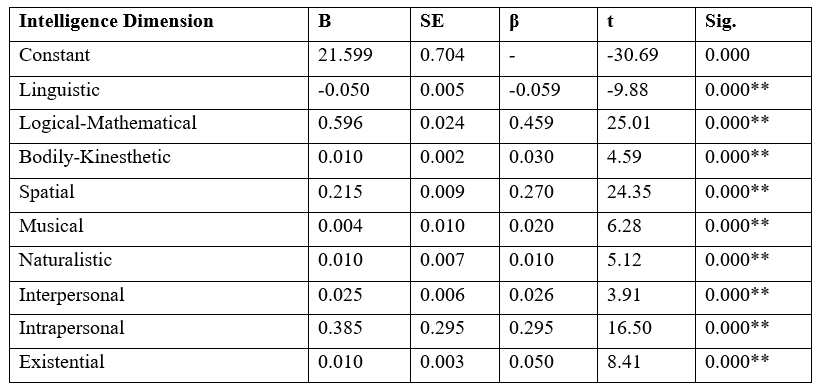
This paper explores the association between the multiple intelligence types and the performance in mathematics of 1,000 secondary school students from the district of Guntur, Andhra Pradesh, India. Using correlational and regression analyses, we analysed the predictive power of Gardner's nine intelligence dimensions (linguistic, logical-mathematical, bodily-kinesthetic, spatial, musical, naturalistic, interpersonal, intrapersonal, and existential) on mathematics performance. There was a significant positive correlation between the multiple intelligence and the mathematics achievement (r=0.240, p<0.01). The association was significant in the χ2 analysis (χ²=14.06, p<0.01). A stepwise regression analysis indicated that composite of intelligence dimensions accounted for 83.35% of the variance in mathematics achievement (R²= 0.8335) and the strongest predictors were logical-mathematical intelligence ((β=0.459, p<0.01), intrapersonal intelligence (β=0.295, p<0.01), and spatial intelligence ((β=0.270, p<0.01). The findings support Gardner's multiple intelligence theory and the implication that mathematical achievement is influenced by different cognitive factors other than the traditional ones. Implications for `differentiated instruction', curriculum and assessment are discussed.
Downloads
References
Anjali, M., & Srinivas, K. V. R. (2025). Geopolitics: status of primary and secondary school education in Andhra Pradesh: During 2013-2023. EPRA International Journal of Research & Development (IJRD), 10(12), 229–240. doi:10.36713/epra2016.
Anjali, M., & Srinivas, K. V. R. (2025). Implementation of right to education - Act provisions in Guntur dist- A study based on primary data in Andhra Pradesh. International Journal of Creative Research Thoughts (IJCRT), 13(11), 88–99. doi:10.56975/ijcrt.v13i11.297819.
Armstrong, T. (2009). Multiple intelligences in the classroom. (3rd ed.). Alexandria, VA: ASCD.
Chittaranjan Nayak. (2002). A study on high school students' scholastic performance in relation to their intelligence and attitude toward education. Indian Educational Review, 38(2), 43-52.
Filiz, A. S. (2010). An investigation into types of multiple intelligences and activities used in English classes at primary schools. Unpublished Master's Thesis, Canakkale Onsekiz Mart University, Turkey.
Gardner, H. (1983). Frames of mind: The theory of multiple intelligences. New York: Basic Books.
Gardner, H. (2011). Frames of mind: The theory of multiple intelligences. (3rd ed.). New York: Basic Books.
Gul, S., Yilmaz, R. M., Kaya, H., & Yilmaz, R. (2020). The effect of learning models and multiple intelligences. International Journal of Instruction, 13(2), 173-188.
Hidayah, I. (2015). Model of independent working group of teachers and its effectiveness on elementary school teachers' proficiency in mathematics instruction. Procedia-Social and Behavioral Sciences, 214, 43-50.
Khan, S. (2018). Teaching mathematics using multiple intelligence approach. New Delhi: APH Publishing.
Mallam, Anjali, & M. Esther Suneela. (2025). Achievement in mathematics of secondary school students. International Journal of Creative Research Thoughts, 13(5), q659–q664. doi:10.56975/ijcrt.v13i5.288315.
Mallam, Anjali, & M. Esther Suneela. (2025). Multiple intelligence of secondary school students. International Journal of Research and Analytical Reviews, 12(2), 114–119. doi:10.56975/ijrar.v12i2.315186.
Murray, L. K. (2016). Teachers' perceptions and practices of multiple intelligences theory in middle schools. Unpublished Doctoral Dissertation, Walden University, Minneapolis.
Priyanka Maurya. (2024). Academic achievement and multiple intelligences of secondary school students. Educational Administration: Theory and Practice, 30(5), 14447-14453.
Sreeraj, K. G. (2015). Relationship between multiple intelligences and achievement in mathematics of students at secondary level. Unpublished Doctoral Dissertation, Mahatma Gandhi University, Kerala.
Vadivukarasi, P. M. (2022). Influence of multiple intelligence on the academic achievement of higher secondary students. International Journal of Health Research, 6(S5), 171-178.
Published
How to Cite
Issue
Section
License
Copyright (c) 2026 Anjali Mallam

This work is licensed under a Creative Commons Attribution 4.0 International License.
Research Articles in 'Social Science Journal for Advanced Research' are Open Access articles published under the Creative Commons CC BY License Creative Commons Attribution 4.0 International License http://creativecommons.org/licenses/by/4.0/. This license allows you to share – copy and redistribute the material in any medium or format. Adapt – remix, transform, and build upon the material for any purpose, even commercially.


