Old-Age Dependency Transition in Major World Economies: Ageing Burden, Economic Implications, and Lessons for India's Emerging Silver Economy
DOI:
https://doi.org/10.54741/SSJAR/6.3.2026.356Keywords:
old-age dependency ratio, population ageing, silver economy, pension sustainability, demographic dividend, india elderly policy, ageing nationsAbstract
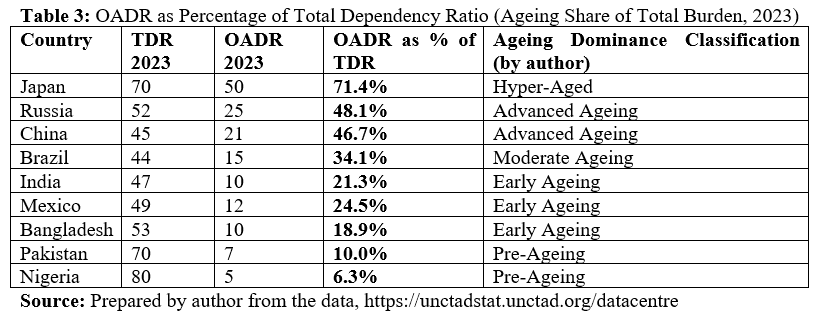
The old-age dependency ratio — defined as the number of people aged 65 and over per 100 people of working age (15-64) — is the most rapidly intensifying demographic pressure in the 21st century. This study presents a comprehensive comparative analysis of OADR trends between eleven of the world’s most populous countries from 1950 to 2023 to be able to identify the speed and magnitude, pattern, and fiscal burden of population ageing. Japan's OADR increased from 8 in 1950 to 50 in 2023, a 525% increase and the most extreme ageing burden. China's OADR increased three times from 7 in 1970 to 21 in 2023, bringing significant pressure on its pension system. India's OADR increased slightly from 5 in 1950 to 10 in 2023, indicating a very favourable but rapidly narrowing window before rapid ageing. Nigeria and Ethiopia are the Sub-Saharan African countries with OADRs under 6, indicative of young population pyramids. Applying descriptive statistics, CAGR analysis, and regression modelling, this paper classifies ageing profiles across major economies and extracts policy implications for India’s emerging challenge of demographic ageing.
Downloads
References
Ankalam, B., & Samson, P. (2026). Demographic transition and total dependency ratio dynamics among world's most populated nations: A comparative analysis with special reference to India. Quest Journals Journal of Research in Humanities and Social Science, 14(4), 184–189. https://doi.org/10.35629/9467-1404184189
Bloom, D. E., Canning, D., & Fink, G. (2010). Implications of population aging for economic growth. Oxford Review of Economic Policy, 26(4), 583–612.
Bongaarts, J. (2004). Population aging and the rising cost of public pensions. Population and Development Review, 30(1), 1–23.
Dreze, J., & Sen, A. (2013). An uncertain glory: India and its contradictions. Princeton University Press.
Ito, T., & Hoshi, T. (2020). The Japanese economy. (2nd ed.). MIT Press.
Ogawa, N., & Matsukura, R. (2005). Ageing in Japan: The health and wealth of the older population. Asian Population Studies, 1(2), 199–226.
Rajan, S. I., & Mishra, U. S. (2019). The ageing-development nexus: Evidence from Indian states. Economic and Political Weekly, 54(19), 37–44.
Published
How to Cite
Issue
Section
License
Copyright (c) 2026 Balakrishna Ankalam, K. V. R. Srinivas

This work is licensed under a Creative Commons Attribution 4.0 International License.
Research Articles in 'Social Science Journal for Advanced Research' are Open Access articles published under the Creative Commons CC BY License Creative Commons Attribution 4.0 International License http://creativecommons.org/licenses/by/4.0/. This license allows you to share – copy and redistribute the material in any medium or format. Adapt – remix, transform, and build upon the material for any purpose, even commercially.


