Inclusive Energy Transitions and SDG 7: Assessing Renewable Energy through the Lens of Justice and Social Fairness
DOI:
https://doi.org/10.54741/SSJAR/6.2.2026.355Keywords:
inclusive energy transition, sustainable development goal 7 (SDG 7), energy justice, renewable energy policy, social fairness, energy justice index, rural electrification, public subsidies, renewable energy investment, sustainable developmentAbstract
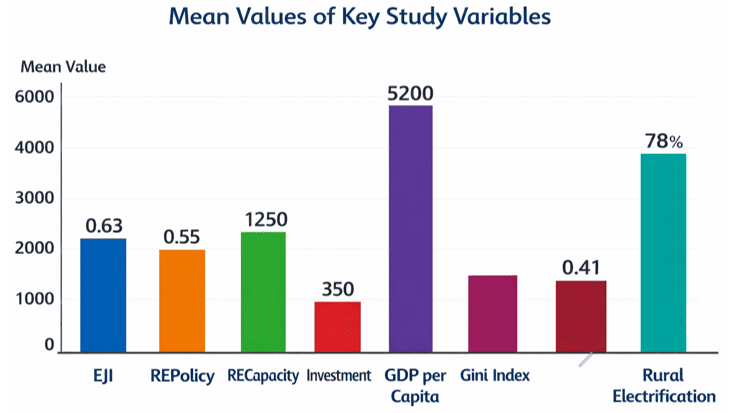
Energy transitions that are inclusive are necessary if SDG 7 is to be achieved since SDG 7 entails making sure that there is universal access to energy that is affordable, sustainable, and reliable. This paper analyzes renewable energy transitions from the perspective of energy justice. Specifically, it will analyze issues relating to equitable access to energy, affordability, and inclusion in energy transition programs in selected developing countries. In order to achieve its objectives, the paper will employ econometric methods using Fixed Effects (FE), Random Effects (RE), System GMM, and PCA analysis to develop an index of energy justice. Results show that the mean value of EJI is 0.63, which means that there is an energy justice condition of moderate magnitude with a huge disparity across nations. The highest contributing factor to the level of EJI is the installed capacity of renewable energy sources (40%), followed by renewable energy policies (35%) and investments (28%). Results from the Fixed Effects model indicate that the presence of renewable energy policy (β = 0.28), installed capacity (β = 0.32), and investment (β = 0.21) positively and significantly contribute to enhancing energy justice, whereas income inequality (β = -0.18) adversely impacts energy justice. The System GMM model shows that renewable energy share (β = 0.029), subsidies provided to consumers (β = 0.017), and rural electrification (β = 0.043) positively affect EJI, while the price of energy (β = -0.052) reduces affordability and inclusiveness.
Downloads
References
Agbaitoro, G. A., & Oyibo, K. I. (2022). Realizing the United Nations sustainable development goals 7 and 13 in sub-Saharan Africa by 2030: Synergizing energy and climate justice perspectives. Journal of World Energy Law & Business, 15(3), 223–235. https://doi.org/10.1093/jwelb/jwac009
Batra, B. (2025). Integrating energy justice and SDGs in solar policy frameworks. Energies, 18(15), 3952. https://doi.org/10.3390/en18153952
Bouzarovski, S., & Simcock, N. (2017). Spatializing energy justice. Energy Policy, 107, 640–648. https://doi.org/10.1016/j.enpol.2017.03.064
Bridge, G., Bouzarovski, S., Bradshaw, M., & Eyre, N. (2018). Geographies of energy transition: Space, place and the low-carbon economy. Energy Policy, 53, 331–340. https://doi.org/10.1016/j.enpol.2012.10.066
Devarajan, Y., Thandavamoorthy, R., Thatoi, D. N., Jangid, P. K., Manjunath, H. R., Zalawadia, J., ... & Mehar, K. (2026). Advancing SDG-7 for affordable and clean energy: decentralized energy access pathways, policy–finance barriers, and AI-enabled transition strategies. International Journal of Sustainable Energy, 45(1), https://doi.org/10.1080/14786451.2026.2620883
Jenkins, K., McCauley, D., Heffron, R., Stephan, H., & Rehner, R. (2016). Energy justice: A conceptual review. Energy Research & Social Science, 11, 174–182. https://doi.org/10.1016/j.erss.2015.10.004
Müller, F., Neumann, M., Elsner, C., & Claar, S. (2021). Assessing African energy transitions: Renewable energy policies, energy justice, and SDG 7. Politics and Governance, 9(1), 119–130. https://doi.org/10.17645/pag.v9i1.3615
Newell, P., & Mulvaney, D. (2013). The political economy of the ‘just transition’. The Geographical Journal, 179(2), 132–140. https://doi.org/10.1111/geoj.12008
Osabohien, R., Imandojemu, K., & Jaaffar, A. H. (2025). Clean energy, environmental policy and energy justice as drivers of sustainable development in OECD countries. Scientific Reports. https://doi.org/10.1038/s41598-025-32759-4
Raman, R., Ustenko, V., Filho, W. L., & Nedungadi, P. (2025). Energy justice and gender: bridging equity, access, and policy for sustainable development. Discover Sustainability, 6(1), 558. https://doi.org/10.1007/s43621-025-01375-7
Samuel, B. C. N. (2026). Energy, environmental justice and sustainable development in emerging economies. International Journal of Research and Innovation in Social Science. https://doi.org/10.47772/IJRISS.2026.10100312
Siciliano, G., Wallbott, L., Urban, F., Dang, A. N., & Lederer, M. (2021). Low‐carbon energy, sustainable development, and justice: Towards a just energy transition for the society and the environment. Sustainable Development, 29(6), 1049-1061. https://doi.org/10.1002/sd.2193
Sohail, M. T., Ullah, S., Ozturk, I., & Sohail, S. (2025). Energy justice, digital infrastructure, and sustainable development: A global analysis. Energy. https://doi.org/10.1016/j.energy.2025.1349993
Sovacool, B. K., Heffron, R. J., McCauley, D., & Goldthau, A. (2016). Energy decisions reframed as justice and ethical concerns. Nature Energy, 1(5), 1-6. https://doi.org/10.1038/nenergy.2016.24
Topaloglou, L. (2025). Exploring climate, energy, and environmental justice. IntechOpen. https://doi.org/10.5772/intechopen.1211929
Villavicencio Calzadilla, P., & Mauger, R. (2018). The UN’s new sustainable development agenda and renewable energy: The challenge to reach SDG7 while achieving energy justice. Journal of Energy & Natural Resources Law, 36(2), 233–254. https://doi.org/10.1080/02646811.2017.1377951
Published
How to Cite
Issue
Section
License
Copyright (c) 2026 Sanjiv Sarkar, Arunkumar. P

This work is licensed under a Creative Commons Attribution 4.0 International License.
Research Articles in 'Social Science Journal for Advanced Research' are Open Access articles published under the Creative Commons CC BY License Creative Commons Attribution 4.0 International License http://creativecommons.org/licenses/by/4.0/. This license allows you to share – copy and redistribute the material in any medium or format. Adapt – remix, transform, and build upon the material for any purpose, even commercially.


