Women at the Negotiating Table: Gender Inclusion and the Durability of Peace Agreements
DOI:
https://doi.org/10.54741/SSJAR/6.2.2026.354Keywords:
women, peace and security (WPS), gender inclusion, peace negotiations, peace agreement durability, feminist peacebuilding, international peace processesAbstract
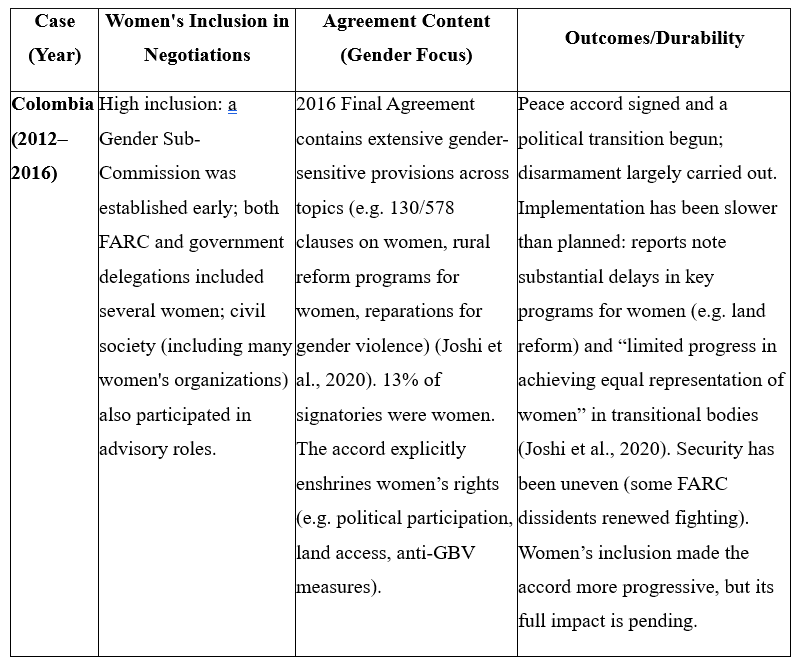
The inclusion of women in peace negotiations is a critical component of international peacebuilding processes in the Women, Peace, and Security agenda. However, women’s inclusion in peace negotiations is still low. This study seeks to explore the impact of gender inclusion in peace negotiations on the effectiveness and sustainability of international peace negotiations. This will be done through a systematic review of the literature, including a comparative case study of peace negotiations in Liberia, Nepal, and Colombia. The findings indicate that the meaningful involvement of women is linked to an expanded agenda in negotiations, robust social provisions in peace agreements, and the legitimacy of negotiated peace agreements. However, the paper also reveals that symbolic inclusion is not sufficient to produce these benefits. The findings conclude that gender inclusion is not just good in itself but is also good for peace agreements.
Downloads
References
Anderson, M. B. (2015). Women building peace: What they do, why it matters. Lynne Rienner Publishers.
https://www.rienner.com/title/Women_Building_Peace_What_They_Do_Why_It_Matters
Anderson, M. J., Corredor, E. S., & Zulver, J. (2024). Rethinking failure: Feminist peacebuilding and the peace continuum in violent and illiberal “Post-Conflict” settings. Global Studies Quarterly, 5(1). https://doi.org/10.1093/isagsq/ksaf008
Bell, C., & O’Rourke, C. (2010). Peace agreements or pieces of paper? The impact of UNSC Resolution 1325 on peace processes and their agreements. International and Comparative Law Quarterly, 59(4), 941–980. https://doi.org/10.1017/S002058931000062X
Caprioli, M. (2005). Primed for violence: The role of gender inequality in predicting internal conflict. International Studies Quarterly, 49(2), 161–178. https://doi.org/10.1111/j.0020-8833.2005.00340.x
Creswell, J. W., & Creswell, J. D. (2018). Research design: Qualitative, quantitative, and mixed methods approaches. (5th ed.). SAGE Publications. https://us.sagepub.com/en-us/nam/research-design/book255675
Inclusive Peace & Transition Initiative. (2016). Women in the Liberia peace process (2003–2011). The Graduate Institute of International and Development Studies.
https://www.inclusivepeace.org/wp-content/uploads/2021/05/case-study-women-liberia-2003-2011-en.pdf
Joshi, M., Quinn, J., Quinn, L., Gindele, R., McQuestion, P., Ramírez Rincón, Á. M., Barometer Initiative, Peace Accords Matrix, Kroc Institute for International Peace Studies, National Secretariat of the Social Pastorate – Cáritas Colombia, Qüid Diseño Esencial, & European Union. (2020). Towards implementation of women’s rights in the colombian final peace accord: progress, opportunities and challenges. In Gerard Martin, Special Report on the Monitoring of the Gender Commitments. https://peaceaccords.nd.edu/wp-content/uploads/2020/11/Towards-Implementation-of-Womens-Rights-in-the-Colombian-Final-Peace-Accord-2.pdf
Kostovicova, D., & Paskhalis, T. (2021). Gender, justice and deliberation: Why women don't influence peacemaking. International Studies Quarterly, 65(2), 263–276. https://doi.org/10.1093/isq/sqab003
Krause, J., Krause, W., & Bränfors, P. (2018). Women’s participation in peace negotiations and the durability of peace. International Interactions, 44(6), 985–1016. https://doi.org/10.1080/03050629.2018.1492386
Markham, S. (2013). Women, peace and security in Nepal: From civil war to post-conflict reconstruction. Routledge. https://doi.org/10.4324/9781315158723
Nilsson, D. (2012). Anchoring the peace: Civil society actors in peace accords and durable peace. International Interactions, 38(2), 243–266. https://doi.org/10.1080/03050629.2012.659139
O’Reilly, M., Súilleabháin, A. Ó., & Paffenholz, T. (2015). Reimagining peacemaking: Women’s roles in peace processes. International Peace Institute. https://www.ipinst.org/2015/06/reimagining-peacemaking-womens-roles-in-peace-processes
Paffenholz, T., Ross, N., Dixon, S., Schluchter, A. L., & True, J. (2016). Making women count—not just counting women: Assessing women’s inclusion and influence on peace negotiations. Inclusive Peace & Transition Initiative. https://www.inclusivepeace.org/publications/making-women-count
Shepherd, L. J. (2016). Making war safe for women? National action plans and the militarisation of the Women, Peace and Security agenda. International Political Science Review, 37(3), 324–335. https://doi.org/10.1177/0192512116629820
Stone, L. (2014). Women transform conflict: A quantitative analysis of female peacemaking. Peace & Change, 39(3), 396–421. https://doi.org/10.1111/pech.12084
True, J. (2012). The political economy of violence against women. Oxford University Press. https://doi.org/10.1093/acprof:oso/9780199755929.001.0001
True, J., & Riveros-Morales, Y. (2019). Towards inclusive peace: Analysing gender-sensitive peace agreements 2000–2016. International Political Science Review, 40(1), 23–40. https://doi.org/10.1177/0192512118808608
UN Women. (2015). Preventing conflict, transforming justice, securing the peace: A global study on the implementation of United Nations Security Council Resolution 1325. https://wps.unwomen.org/
United Nations Security Council. (2000). Resolution 1325 on women, peace and security. https://undocs.org/S/RES/1325(2000)
United Nations Security Council. (2019). Women, peace and security: Report of the Secretary-General. https://undocs.org/S/2019/800
Published
How to Cite
Issue
Section
License
Copyright (c) 2026 Harmeet Kaur

This work is licensed under a Creative Commons Attribution 4.0 International License.
Research Articles in 'Social Science Journal for Advanced Research' are Open Access articles published under the Creative Commons CC BY License Creative Commons Attribution 4.0 International License http://creativecommons.org/licenses/by/4.0/. This license allows you to share – copy and redistribute the material in any medium or format. Adapt – remix, transform, and build upon the material for any purpose, even commercially.


