Gender Wage Disparities in Agricultural Labour Markets: Evidence from Uttar Pradesh, India
DOI:
https://doi.org/10.54741/SSJAR/6.2.2026.353Keywords:
gender wage gap, agricultural labour, wage inequality, labour force participation, uttar pradesh, PLFS, rural labour marketAbstract
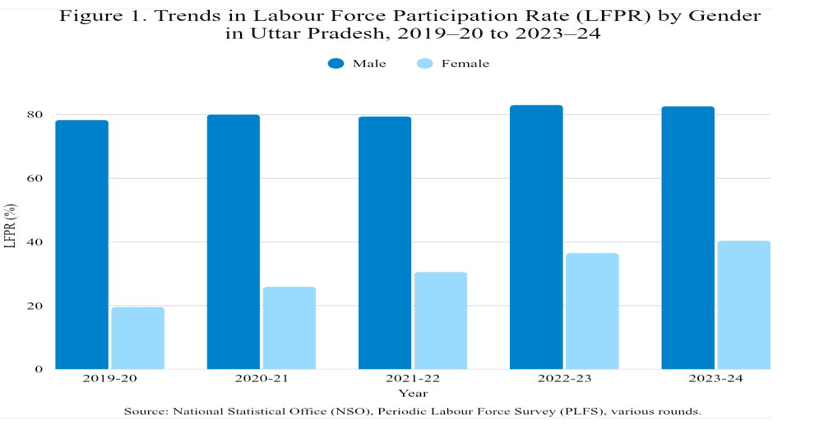
Gender wage disparities remain a persistent feature of agricultural labour markets in developing economies. In India, agriculture provides employment to a large share of the rural workforce, particularly women. This study examines gender wage differences among agricultural wage labourers aged 15–59 years in Uttar Pradesh using recent rounds of the Periodic Labour Force Survey (PLFS) and Agricultural Wages in India (AWI). Labour force participation rates (LFPR) and average daily wages were analysed to assess trends and gaps. The LFPR gap between men and women declined from 58.7% in 2019–20 to 42.2% in 2023–24, while the gender wage gap decreased from 7.7% to 5.9% over the same period. Despite improvements, women continue to earn less than men due to occupational segregation and structural inequalities in rural labour markets. The study highlights the need for policies promoting equal wages, skill development, and diversified employment opportunities to reduce gender disparities in agricultural work.
Downloads
References
Ministry of Statistics and Programme Implementation (MoSPI), National Sample Survey Office (NSSO). (2024). Annual report, PLFS, 2023-24. Government of India. https://www.mospi.gov.in/download-reports
Ministry of Agriculture and Farmers Welfare. (2024). Agricultural wages in India 2023–24. Directorate of Economics and Statistics, Government of India. https://desagri.gov.in/wp-content/uploads/2025/07/AWI-2023-24-for-printing-uploading-1.pdf
Becker, G. S. (1964). Human capital: A theoretical and empirical analysis. University of Chicago Press. https://press.uchicago.edu/ucp/books/book/chicago/H/bo3684033.html
Oaxaca, R. (1973). Male-female wage differentials in urban labor markets. International Economic Review, 14(3), 693–709. https://doi.org/10.2307/2525981
Kundu, A., & Das, S. (2019). Gender wage gap in the agricultural labor market of India: An empirical analysis. Journal of Economics and Political Economy. https://journals.econsciences.com/index.php/JEPE/article/view/1872
Merfeld, J. D. (2021). Sectoral wage gaps and gender in rural India. IZA Discussion Paper No. 14391. https://www.iza.org/publications/dp/14391/sectoral-wage-gaps-and-gender-in-rural-india
Singh, V., Patel, S., & Singh, R. (2023). Analyzing gender disparities in land ownership and wage rates in Indian agriculture. Asian Journal of Agricultural Extension, Economics & Sociology. https://journalajaees.com/index.php/AJAEES/article/view/2087
Tiwari, S., & Prawal, S. (2024). Socio-economic analysis of agricultural labourers and wage disparities. Management Journal for Advanced Research. https://mjar.singhpublication.com/index.php/ojs/article/view/216
Rajni, V. (2026). Post-MGNREGA agricultural wage trends in Uttar Pradesh. Social Science Journal for Advanced Research. https://ssjar.singhpublication.com/index.php/ojs/article/view/311
Ministry of Statistics and Programme Implementation. (2023). Periodic Labour Force Survey: Annual report 2022–23. Government of India. https://mospi.gov.in/publication/annual-report-periodic-labour-force-survey-plfs-july-2022-june-2023
National Statistical Office. (2021). Periodic Labour Force Survey (PLFS) 2019–20: Annual report. Ministry of Statistics and Programme Implementation, Government of India. https://mospi.gov.in/sites/default/files/publication_reports/Annual_Report_PLFS_2019_20F1.pdf
National Statistical Office. (2022). Periodic Labour Force Survey (PLFS) 2020–21: Annual report. Ministry of Statistics and Programme Implementation, Government of India. https://www.mospi.gov.in/sites/default/files/publication_reports/Annual_Report_PLFS_2020%2021_0.pdf
National Statistical Office. (2023). Periodic Labour Force Survey (PLFS) 2021–22: Annual report. Ministry of Statistics and Programme Implementation, Government of India. https://www.mospi.gov.in/sites/default/files/publication_reports/AnnualReportPLFS2021-22F1.pdf
National Statistical Office. (2024). Periodic Labour Force Survey (PLFS) 2022–23: Annual report. Ministry of Statistics and Programme Implementation, Government of India. https://www.mospi.gov.in/sites/default/files/publication_reports/AR_PLFS_2022_23N.pdf
Renu. (2023). Determinants of female workforce participation in agriculture of Uttar Pradesh, India. Current Agriculture Research Journal, 11(1).https://www.agriculturejournal.org/volume11number1/determinants-of-female-workforce-participation-in-agriculture-of-uttar-pradesh-india/
Banerjee, P., & Bhat, A. H. (2025). Invisible hands: Unveiling the socio-economic contributions of rural women in agriculture.https://www.cdpp.co.in/articles/invisible-hands-unveiling-the-socio-economic-contributions-of-rural-women-in-agriculture/
Published
How to Cite
Issue
Section
License
Copyright (c) 2026 Mitali Kamal, Vandana Dwivedi

This work is licensed under a Creative Commons Attribution 4.0 International License.
Research Articles in 'Social Science Journal for Advanced Research' are Open Access articles published under the Creative Commons CC BY License Creative Commons Attribution 4.0 International License http://creativecommons.org/licenses/by/4.0/. This license allows you to share – copy and redistribute the material in any medium or format. Adapt – remix, transform, and build upon the material for any purpose, even commercially.


