Influence of Employment and Investment in Circular Economy on the Economic Growth of EU Countries: A Dynamic panel Data Regression Approach (2008-2024)
DOI:
https://doi.org/10.54741/SSJAR/6.2.2026.343Keywords:
circular economy, economic growth, employment, investment and dynamic panelAbstract
It is widely recognised that the circular economy has gained substantial traction across countries due to its strong potential to promote sustainable development. By minimizing waste and pollution, reducing reliance on raw materials, generating employment opportunities, and safeguarding the environment, this model offers a comprehensive approach to economic growth. Unlike the traditional linear economic framework, which follows a “take–make–dispose” pattern, the circular economy emphasizes value retention and regeneration, thereby enhancing long-term growth prospects for nations.
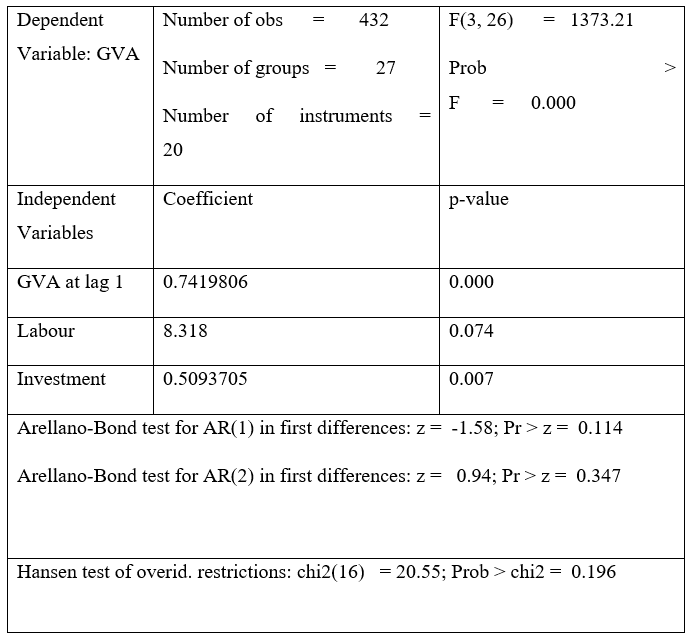
In this study, we consider all countries within the European Union and utilize data at constant prices covering the period from 2008 to 2024. The empirical findings indicate that investment in the circular economy exerts a positive and highly significant impact on gross value added (GVA). Labour also demonstrates a positive influence on GVA, although its level of significance is comparatively moderate. Furthermore, when examining the growth of GVA derived from circular economy activities, investment continues to show a strong positive and statistically significant effect.
Downloads
References
Apostu, S. A., Gigauri, I., Panait, M., & Martín-Cervantes, P. A. (2023). Is Europe on the way to sustainable development? Compatibility of green environment, economic growth, and circular economy issues. International Journal of Environmental Research and Public Health, 20(2), 1078. https://doi.org/10.3390/ijerph20021078
Apostu, S. A., Hussain, A., Kijkasiwat, P., & Vasa, L. (2022). A comparative study of the relationship between circular economy, economic growth, and oil price across South Asian countries. Frontiers in Environmental Science, 10, 1036889. https://doi.org/10.3389/fenvs.2022.1036889
Kolpinski, & Kratzer. (2024). Zooming out: Circular economy development in the European Union and its implications on the economy and society. Journal of Circular Economy, 2(4).
Laubinger, F., Lanzi, E., & Chateau, J. (2020). Labour market consequences of a transition to a circular economy: A review paper. (OECD Environment Working Papers No. 162). OECD Publishing.
Mehmood, A., Ahmed, S., Viza, E., Bogush, A., & Ayyub, R. M. (2021). Drivers and barriers towards circular economy in agri-food supply chain: A review. Business Strategy and Development, 4(4), 465–481. https://doi.org/10.1002/bsd2.171
Mohsin, M., Kamran, H. W., Nawaz, M. A., Hussain, M. S., & Dahri, A. S. (2021). Assessing the impact of transition from non-renable to renewable energy consumption on economic growth–environmental nexus from developing Asian economies. Journal of Environmental Management, 284, 111999. https://doi.org/10.1016/j.jenvman.2021.111999
Sverko Grdic, Z., Krstinic Nizic, M., & Rudan, E. (2020). Circular economy concept in the context of economic development in EU countries. Sustainability, 12(7), 3060. https://doi.org/10.3390/su12073060
Published
How to Cite
Issue
Section
License
Copyright (c) 2026 Surajit Sengupta, Subir Das, Shreyasi Chatterjee

This work is licensed under a Creative Commons Attribution 4.0 International License.
Research Articles in 'Social Science Journal for Advanced Research' are Open Access articles published under the Creative Commons CC BY License Creative Commons Attribution 4.0 International License http://creativecommons.org/licenses/by/4.0/. This license allows you to share – copy and redistribute the material in any medium or format. Adapt – remix, transform, and build upon the material for any purpose, even commercially.


