The Ascendancy of Ambedkarite Social Justice Philosophy Among the Youth of South Assam, India: A Study on the Disjuncture between Conceptual Awareness and Grassroots Praxis
DOI:
https://doi.org/10.54741/SSJAR/6.2.2026.338Keywords:
Dr. B.R. Ambedkar, social justice philosophy, domain paradox, internalized meritocracy, conceptual awarenessAbstract
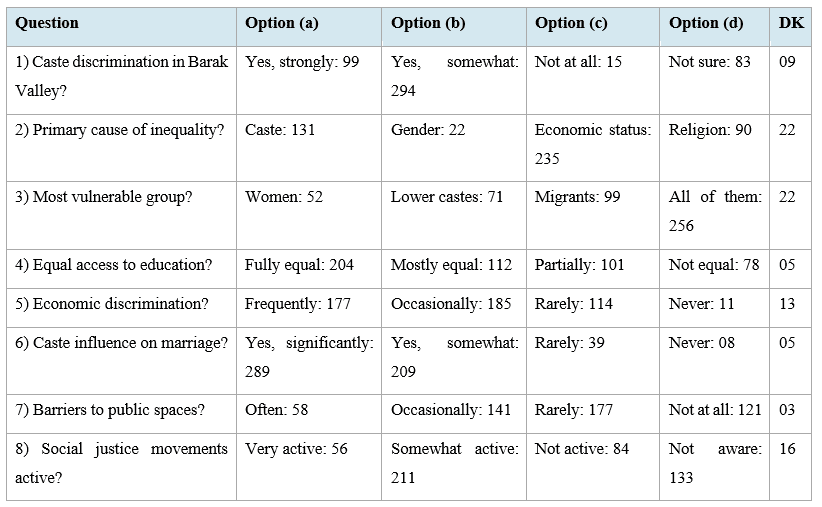
Though there is a plethora of discussion among scholars about Dr. B. R. Ambedkar’s philosophy of social justice, the reception of this philosophy among the youth of Northeast India, especially the geographically and linguistically distinct region of South Assam (Barak Valley), remains a topic of investigation. This paper tries to explore the understanding and practice of Ambedkarism among 500 graduate students of South Assam. The quantitative data reveals that the level of awareness of Ambedkarite ideology among students is high, with 84.6% of students aware of Ambedkar as a social reformer and 96.6% of students aware of Ambedkar's mission of achieving social justice. The research also reveals an important phenomenon of "Implementation Gap," where 56.8% of students are not aware of social organizations in their region. The research also reveals another phenomenon of "Domain Paradox," where students hold the public domain of education and society to be meritocratic and egalitarian but hold the private domain of kinship and marital relations to be rigidly stratified by caste. This change in the domain of students, from a focus on collective mobilization to internalized meritocracy, has serious consequences for the future of Ambedkarite movements in the region. The research concludes with some recommendations to bridge the gap between theory and practice.
Downloads
References
Bhat, M. A., & Shamim, A. (2025). The psychological burden of reservation: Identity fatigue and internalized meritocracy in contemporary India. Journal of Social Inclusion Research, 12(2), 88–104.
Bonilla-Silva, E. (2006). Racism without racists: Color-blind racism and the persistence of racial inequality in the United States. (2nd ed.). Rowman & Littlefield.
Bosé, A. B. (1994). The Scheduled Castes: An overview. National Book Trust.
Bourdieu, P. (1986). The forms of capital. in J. Richardson (Ed.), Handbook of theory and research for the sociology of education (pp. 241–258). Greenwood.
Butalia, U. (1998). The other side of silence: Voices from the partition of India. Penguin Books India.
Chakraborty, S. (2022). Agrarian selves to refugee selves: The Scheduled Castes of South Assam and the curious flux of social justice. Northeast Indian Review of Sociology, 9(1), 112–129.
Choudhury, P. (2021). The Kaibarta refugees of Barak Valley: Displacement and the politics of identity. Assam University Press.
Dharavath, S. (2025). Ambedkarism as counter-memory: Subverting Brahmanical hegemony in northeast India. Dalit Studies Quarterly, 4(1), 15–33.
Gramsci, A. (1971). Selections from the prison notebooks (Q. Hoare & G. N. Smith, Eds. & Trans.). International Publishers. (Original work published 1929–1935).
Guru, G., & Sarukkai, S. (2012). The cracked mirror: An Indian debate on experience and theory. Oxford University Press.
Mallick, B., & Das, A. K. (2012). Migration and recognition of Patni community in post-independence India. International Research Journal of Social Sciences, 1(3), 41–44.
Mannheim, K. (1936). Ideology and utopia: An introduction to the sociology of knowledge (L. Wirth & E. Shils, Trans.). Harcourt, Brace & World. (Original work published 1929).
McAdam, D., Tarrow, S., & Tilly, C. (2001). Dynamics of contention. Cambridge University Press.
More, S. S. (2018). The educational thoughts of Dr. B. R. Ambedkar. Prasanna Prakashan.
Roy, S. (2018). Referendum and displacement in demographic transition in Barak Valley of Assam. International Journal of Humanities and Social Science Invention, 5(3), 42–48.
Seekings, J., & Nattrass, N. (2005). Class, race, and inequality in South Africa. Yale University Press.
Sutradhar, R. (2019). Dalit struggle for education: With special reference to Barak Valley. International Journal of Science and Research, 3(12), 2167–2171. https://dx.doi.org/10.21275/SUB
Tandon, R. (2025). From symbolic representation to substantive participation: The evolving landscape of social justice. Indian Political Science Review, 59(1), 54–72.
Published
How to Cite
Issue
Section
License
Copyright (c) 2026 Maumita Nath, Debotosh Chakraborty, Bishal Das

This work is licensed under a Creative Commons Attribution 4.0 International License.
Research Articles in 'Social Science Journal for Advanced Research' are Open Access articles published under the Creative Commons CC BY License Creative Commons Attribution 4.0 International License http://creativecommons.org/licenses/by/4.0/. This license allows you to share – copy and redistribute the material in any medium or format. Adapt – remix, transform, and build upon the material for any purpose, even commercially.


