Global and Macroeconomic Determinants of Indian Rupee Depreciation Against the US Dollar: Evidence from an ARDL Framework
DOI:
https://doi.org/10.54741/SSJAR/6.1.2026.313Keywords:
indian rupee, exchange rate depreciation, crude oil prices, US dollar index, ARDL model, macroeconomic stabilityAbstract
Movements in the Indian Rupee against the US Dollar have important implications for macroeconomic stability in India. Exchange rate depreciation affects inflation, trade balance, and overall economic performance. This study examines the key macroeconomic and global factors influencing the depreciation of the Indian Rupee against the US Dollar using quarterly time-series data from 2010Q1 to 2024Q4.
The study applies an Autoregressive Distributed Lag (ARDL) approach to analyse short-run and long-run relationships between the exchange rate and selected variables, including crude oil prices, inflation differential, interest rate differential, and the US Dollar Index. Stationarity of the variables is examined using the Augmented Dickey–Fuller test, and the ARDL bounds testing approach is used to assess the existence of long-run relationships.
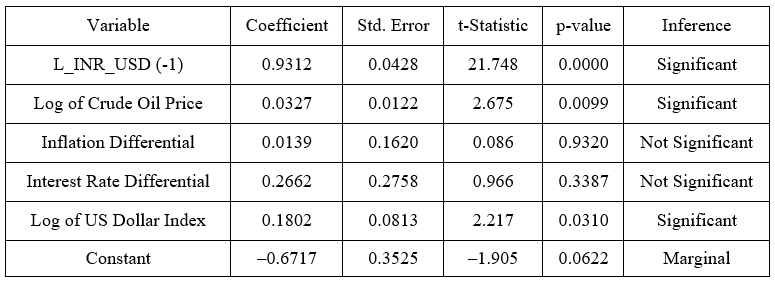
The empirical results indicate that crude oil prices and global dollar strength have a statistically significant impact on the depreciation of the Indian Rupee in the short run. In contrast, inflation and interest rate differentials do not show significant effects. The bounds test does not provide strong evidence of long-run cointegration, suggesting that exchange rate movements are largely driven by short-term external shocks rather than stable long-run fundamentals. The findings highlight India’s vulnerability to global economic conditions and underline the importance of external sector management for maintaining macroeconomic stability.
Downloads
References
Basher, S. A., & Sadorsky, P. (2006). Oil price risk and emerging stock markets. Global Finance Journal, 17(2), 224–251. https://doi.org/10.1016/j.gfj.2006.04.001
Dornbusch, R. (1976). Expectations and exchange rate dynamics. Journal of Political Economy, 84(6), 1161–1176. https://doi.org/10.1086/260506
Frankel, J. A. (2014). Effects of speculation and interest rates in a “carry trade” model of exchange rate determination. Journal of International Money and Finance, 47, 50–63. https://doi.org/10.1016/j.jimonfin.2014.05.004
Frenkel, J. A. (1976). A monetary approach to the exchange rate: Doctrinal aspects and empirical evidence. Scandinavian Journal of Economics, 78(2), 200–224. https://doi.org/10.2307/3439924
Ghosh, S. (2011). Examining crude oil price–exchange rate nexus for India: Evidence from linear and nonlinear cointegration tests. Applied Economics Letters, 18(7), 639–646. https://doi.org/10.1080/13504851.2010.505553
Ghosh, A. R., Gulde, A. M., & Wolf, H. C. (2003). Exchange rate regimes: Choices and consequences. MIT Press.
International Monetary Fund. (2020). Global financial stability report: Bridge to recovery. IMF. https://www.imf.org
Narayan, P. K. (2005). The saving and investment nexus for China: Evidence from cointegration tests. Applied Economics, 37(17), 1979–1990. https://doi.org/10.1080/00036840500278103
Narayan, P. K., Narayan, S., & Prasad, A. (2008). Understanding the oil price–exchange rate nexus for the Fiji Islands. Energy Economics, 30(5), 2686–2696. https://doi.org/10.1016/j.eneco.2008.03.005
Patra, M. D., & Kapur, M. (2012). Alternative exchange rate regimes for India. Economic and Political Weekly, 47(16), 79–88.
Pesaran, M. H., Shin, Y., & Smith, R. J. (2001). Bounds testing approaches to the analysis of level relationships. Journal of Applied Econometrics, 16(3), 289–326. https://doi.org/10.1002/jae.616
Reserve Bank of India. (2022). Report on currency and finance. RBI. https://www.rbi.org.in
Rey, H. (2015). Dilemma not trilemma: The global financial cycle and monetary policy independence. Journal of Economic Perspectives, 29(4), 1–22. https://doi.org/10.1257/jep.29.4.1
Taylor, M. P., & Taylor, A. M. (2004). The purchasing power parity debate. Journal of Economic Perspectives, 18(4), 135–158. https://doi.org/10.1257/0895330042632744
World Bank. (2021). Global economic prospects. World Bank. https://www.worldbank.org
Published
How to Cite
Issue
Section
License
Copyright (c) 2026 Doyel Aich, Shankhadeep Mondal

This work is licensed under a Creative Commons Attribution 4.0 International License.
Research Articles in 'Social Science Journal for Advanced Research' are Open Access articles published under the Creative Commons CC BY License Creative Commons Attribution 4.0 International License http://creativecommons.org/licenses/by/4.0/. This license allows you to share – copy and redistribute the material in any medium or format. Adapt – remix, transform, and build upon the material for any purpose, even commercially.


