Nikhilesh and Sandeep: The Embodiment of Tagore’s Notion of Society and State
DOI:
https://doi.org/10.5281/zenodo.17452176Keywords:
rabindranath tagore, swadeshi movement, boycott, atmasakti, indian and european civilizations, society-stateAbstract
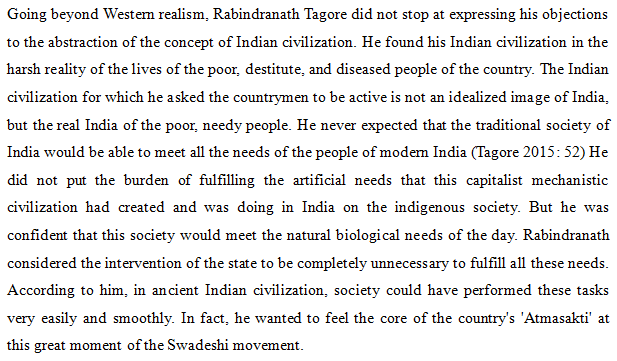
Rabindranath Tagore is a world-renowned poet. But his identity does not end here. Tagore is a poet-lyricist, Tagore is a story-novel-playwright, Tagore is a critic-essayist-philosopher, and even Tagore is a painter. In the present article, the topic of discussion is Rabindranath Tagore's social thought. His socio-political and economic views are our subject of consideration. In the bright light of Rabindranath Tagore's wisdom, various aspects of human civilization and culture have been illuminated. The world poet had thought about various issues of human life and had expressed his opinions in a clear manner. His strong connection with the larger history of the country and the nation is well known. His writings are tireless in transcribing the thoughts and ideas that all these issues created in his mind. The political environment of India was unstable during the emergence of Rabindranath Tagore. In the meantime, he kept himself steadfast and thought about contemporary political events and issues and expressed his opinions. He was in favor of the indivisible unity and solidarity of mankind. Therefore, he published the novel ‘Ghore Baire' in 'Sabuj Patrika' about the contemporary situation during the Bengal Partition Movement. While on one hand, Sandeep is a representative of 'state-centric' European civilization; on the other hand, Nikhilesh is seen as a symbol of 'society-centric' Indian civilization. During the period 1910-1925, issues like communalism, imperialism, social reform, and superstition were the central themes of Tagore's socio-political thought. Tagore's independent judgment and in depth conscience were expressed in the discussion of Indian politics. His enthusiasm for establishing the entire country and nation in its own glory before the entire native people is undeniable. Tagore's socio-political thought is a dynamic subject. The existence of contradictory views is observed in his thought. He had a fondness for the calm, gentle, and bright ideals of the ancient Indian asceticism. His sincerity towards the independence of India and the people of India is undeniable. He had guided his long-term political thought by connecting it with the changing trends of life and time. That is why the conflict between good and evil can be seen in the novel ‘Ghore Baire' by humanitarian Rabindranath Tagore.
Downloads
References
Bharthi, K.S. (1998). The political thought of Rabindranath Tagore. New Delhi: Concept Publishing Company Pvt. Ltd.
Chatterjee, P. (1993). Nationalist thought and colonial world: A derivative discourse. Chicago: The University of Minnesota Press.
Jana, M. (1960). Rabindranather uponyash (Sahitya O Samaj). Calcutta: Bharoti Book Stall.
Ray, S. (2010). Rabindranather chintajogot. Kolkata: Gronthalay Pvt. Ltd.
Sen, S. (1947). Political thought of tagore. Calcutta: General Printer and Publishers.
Tagore, R. (1905). Atmasakti. Calcutta: Dinomoyi Press.
Tagore, R. (1917). Nationalism. New York: Macmillan.
Tagore, R. (1926). Ghore baire. Calcutta: Biswabharati Granthalay.
Published
How to Cite
Issue
Section
License
Copyright (c) 2025 Nondini Ray

This work is licensed under a Creative Commons Attribution 4.0 International License.
Research Articles in 'Social Science Journal for Advanced Research' are Open Access articles published under the Creative Commons CC BY License Creative Commons Attribution 4.0 International License http://creativecommons.org/licenses/by/4.0/. This license allows you to share – copy and redistribute the material in any medium or format. Adapt – remix, transform, and build upon the material for any purpose, even commercially.


