Beyond the Brinks: Social Attitude towards the Third Gender Community of Assam and Nagaland
DOI:
https://doi.org/10.5281/zenodo.17441713Keywords:
social attitude, third gender, hostile, social justiceAbstract
Social attitude, according to the American Psychological Association, refers to “a person’s general disposition or manner toward other people” which can be “friendly or hostile”. History reruns factuality of the dominant who mostly are the previleged people/groups. They face friendly attitude from society at large, while the marginalized are the underprevileged ones, who mostly face hostile attitude from society. The Third Gender community is one of those marginalized categories who face negative attitude from society. Under the backdrop, it was sought to take up this study which is part of a larger project. Based on interviews from third gender people of Assam and Nagaland, conducted through snowball sampling method, the research was conducted. The primary data so analysed using mixed methods of research, suggests that majority of the third genders from the two states have faced unfriendly and unpleasent social attitude. Hence, I argue that such attitude further propels the third gender community outside the brinks of society, which in place of inclusion enhances the gap towards exclusion. It is essential to minimise this gap so as to to reach the ideals of social justice.
Downloads
References
APA Dictionary of Psychology (Official Website of American Psychological Association)
Available at: https://dictionary.apa.org/social-attitude
Babar, A. (2016). Third gender: The quest for justice, liberty and equality. in V. Dhanaraju, & K.N. Singh (Eds.), Contesting Gender: History Politics and Identity (pp. 69-78). New Delhi: Dominant Publishers and Distributers.
Chakraborty, S. (2016). Holde golap [Yellow Rose]. Kolkata: Dey's Publishing House.
Civil Original Jurisdiction Judgement. (April 15, 2014). New Delhi: Supreme Court of India.
Glossary of Gender and Transgender Terms. (2010, January). Retrieved November 25, 2016, from http://www.fenwayhealth.org/documents/the-fenway-institute/handouts/Handout_7-C_Glossary_of_Gender_and_Transgender_Terms__fi.pdf
Hinchy, J. (2014). Deviant domesticities and sexualised childhoods: Prostitutes, eunuchs and the limits of the state child “Rescue” mission in colonial India. in H. Choi & M. Jolly (Eds.), Divine Domesticities: Christian Paradoxes in Asia and the Pacific (pp. 247–280). ANU Press. http://www.jstor.com/stable/j.ctt13wwvck.14
Hinchy, J. (2019). Governing gender and sexuality in colonial India: The hijra. Cambridge University Press.
Hossain, A. (2021). Beyond emasculation: Pleasure and power in the making of hijras in Bangladesh. Cambridge University Press.
Hossain, A., et al. (2022). Badhai: Hijra-Khwaja Sira-Trans performance across borders in South Asia (Forms of Drama). Bloomsbury Publishing Plc.
Jogathi, M., & Bhat, H. (2023). From manjunath to manjamma. Harper Collins.
Kallinkeel, S. (2020). The Rasaathi: The other side of a transgender. Bookmitra.
Khurai, S. (2023). The yellow sparrow: Memoir of a transgender. Speaking Tiger.
Kumar, P. (2014). Queering Indian sociology: A critical Engagement (CAS Working Paper). New Delhi: Jawaharlal Nehru University. Retrieved November 25, 2016 from: http://www.jnu.ac.in/SSS/CSSS/images/working-paper/Pushpesh.pdf
Majumdar, A., & Basu, N. (2011). Bharater hijrah samaj [India's Hijra Community]. Kolkata: Deep Prakashan. (Original work published 1997).
Majumder, A. (2017). Hijreh duniar khetrasamiksha [Field Survey of the Hijra World]. Kolkata: Deep Prakashan.
Majumder, A., & Tarafder, R. (2019). A scientific aspect of transgenders. Notion Press.
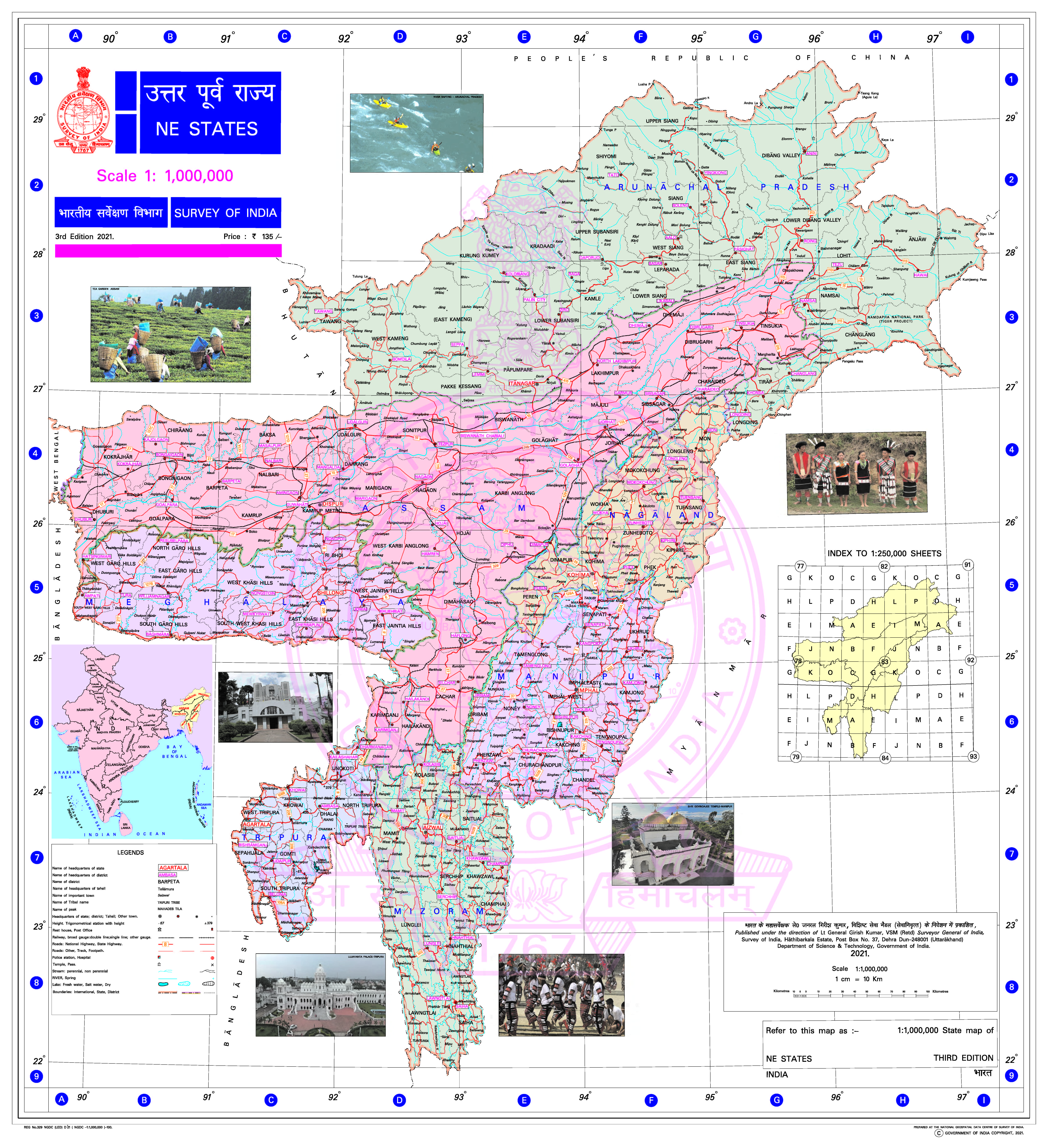
Map of Northeasst India. https://www.surveyofindia.gov.in/documents/uploads/document-84485-north-east-map.jpg
Mishra, V. (2023). Transgenders in India: An introduction. Routledge.
Nanda, S. (1999). Neither man nor woman: The hijras of India. (2nd ed.). Belmont, CA: Wadsworth. (Original work published 1990).
Nandi, E. (2024). Embedding subversion and gender identity: ‘Ulti’, the secret language of the Hijra-Koti community. Tulika Books India.
Padmashali, A. (2022). A small step in a long journey: A memoir. Zubaan Publishers Pvt. Ltd.
Roughgarden, J. (2004). Evolution’s rainbow: Diversity, gender, and sexuality in nature and people. University of California Press.
Saria, V. (2023). Hijras, lovers, brothers: Surviving sex and poverty in rural India. Oxford University Press.
Subramaniam, K. (2021). We are not the others: Reflections of a transgender artivist. Notion Press Media Pvt. Ltd.
Sutradhar, R. (2016). Caste, gender and marginalization: With special reference to the urban wage earners of cachar. in V. Dhanaraju (ed.), The Idea of Caste (pp. 183-202). New Delhi: Dominanat Publishers.
Sutradhar, R. (2019a, November 22-23). Marginal voices: Reading the truth about me by a. revathi [Paper presentation]. Interdisciplinary Studies: Redefining Boundaries of Humanities, Science and Social Sciences, Manipur University, Manipur.
Sutradhar, R. (2019b). Rendering third gender writings: With special focus to ‘Endless Bondage’ by Manobi Bandyopadhyay. Journal of Arts, Culture, Philosophy, Religion, Language and Literature, 3(5), 404-407.
Sutradhar, R. (2020a). Education beyond the gender binary: A study on the hijras of cachar district, Assam (India). in J. Mete & S. K. Roy (eds.), Education and its Consequences in Present Era (pp. 242-249). Ghaziabad: N.B. Publications.
Sutradhar, R. (2020b). Marginality theory in academic discourses.
M. Subha, P. Indumathi, & U. Pushpalatha (eds.). Indian Writing and Translation in English: Literature, Culture and Media. Kenya: Royallite.
Sutradhar, R. (2020c). Notes on sex/gender and the intersex: Understanding intersexuality through the lens of genetic variations. in R. Sutradhar & M. Parvin (eds.), Readings in Sex and Gender (Society, Politics and education) (pp. 76-88). Ghaziabad: N.B. Publications.
Sutradhar, R. (2020d). Political marginalization and socio-cultural suppression of the marginalized groups: A case study of the hijras in south Assam and north Bengal [PhD Thesis, Assam University]. https://shodhganga.inflibnet.ac.in/handle/10603/431070?mode=full
Sutradhar, R. (2021). Contradiction/Concurrence of castration and the fertile phallus: A transgender reading of ancient Indian literature [Manuscipt in preparation]. in D. Vakoch (ed.), Transgender India: Understanding Third gender Identities and Experiences through the Social Sciences, arts and Humanities. Cambridge University Press, San Francisco.
Published
How to Cite
Issue
Section
License
Copyright (c) 2025 Ruman Sutradhar

This work is licensed under a Creative Commons Attribution 4.0 International License.
Research Articles in 'Social Science Journal for Advanced Research' are Open Access articles published under the Creative Commons CC BY License Creative Commons Attribution 4.0 International License http://creativecommons.org/licenses/by/4.0/. This license allows you to share – copy and redistribute the material in any medium or format. Adapt – remix, transform, and build upon the material for any purpose, even commercially.