From UPI to FREE-AI: India’s Policy Transition towards Intelligent Financial Governance
DOI:
https://doi.org/10.5281/zenodo.17284450Keywords:
unified payments interface, framework for responsible and ethical enablement of artificial intelligence, intelligent financial governance quality (IFGQ), digital payments, AI governance maturity, data protection compliance, DPI-enabled credit integrationAbstract
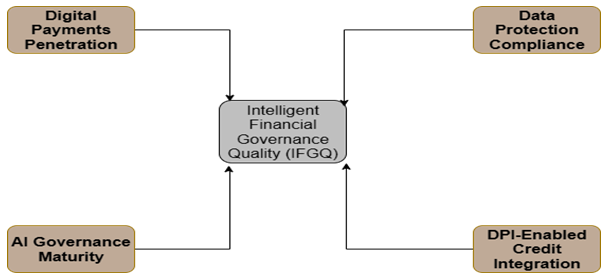
This paper examines the transition of India's financial sector from infrastructure-centric digital public infrastructure to AI-driven governance frameworks. This report looks at how the Unified Payments Interface ecosystem, which made 19.47 billion transactions worth ₹25.08 lakh crore in July 2025, sets the stage for the RBI's Framework for Responsible and Ethical Enablement of Artificial Intelligence to be put into action. The mixed-methods research combines an interrupted time-series design focused on the August 2025 FREE-AI declaration with an analysis of policy documents related to digital payments, data protection, and credit infrastructure. The main sources of data are NPCI transaction data, Account Aggregator adoption metrics that show 100 million consents by August 2024, and PTPFC pilot implementation data that has been available since August 2023. The methodology creates an Intelligent Financial Governance Quality index that measures how much progress has been made in the areas of fairness, consumer protection, and supervisory effectiveness in each sector. Early research shows that UPI's high transaction volume and the Account Aggregator framework's 1059% growth in FY 2023-24 provide enough scale for FREE-AI's governance systems. The report says that India's progressive policy development in areas like payment systems, data protection, and AI governance creates measurable bases for smart financial control while still respecting people's privacy and following the rules.
Downloads
References
Azb Partners. (2023, September 10). Digital personal data protection act, 2023 – Key highlights. Retrieved from: https://www.azbpartners.com/bank/digital-personal-data-protection-act-2023-key-highlights/
Bhattacharyya, P., Gupta, M., & Rao, K. (2025). Framework for responsible and ethical enablement of artificial intelligence (FREE-AI) in India’s financial sector. RBI Innovation Hub Report.
Bernal, J. L., Cummins, S., & Gasparrini, A. (2017). Interrupted time series regression for the evaluation of public health interventions: A tutorial. International Journal of Epidemiology, 46(1), 348–355. https://doi.org/10.1093/ije/dyw098
Box, G. E. P., & Tiao, G. C. (1975). Intervention analysis with applications to economic and environmental problems. Journal of the American Statistical Association, 70(349), 70–79. https://doi.org/10.1080/01621459.1975.10482091
CGAP. (2025, April 2). Convenience drives rapid adoption of Account Aggregators in India. Retrieved from: https://www.cgap.org/blog/convenience-drives-rapid-adoption-of-account-aggregators-in-india
Consent.in. (2025, May 9). Regulator's urgent call to action: Why DPDP compliance cannot wait. Retrieved from: https://www.consent.in/blog/dpdp-regulators
Economic Times. (2025, July 31). UPI transactions hit record high of 19.47 bn in July; NPCI limits balance check to 50. Retrieved from: https://economictimes.com/news/economy/finance/upi-transactions-hit-record-high-of-19-47-bn-in-july-npci-limits-balance-check-to-50/day/articleshow/123046736.cms
Financial Times/Reuters. (2025, August 13). India cenbank committee recommends AI framework for finance sector. Retrieved from: https://www.reuters.com/sustainability/boards-policy-regulation/india-cenbank-committee-recommends-ai-framework-finance-sector-2025-08-13/
FINOS. (2024, September 30). FINOS releases first draft of AI Governance Framework for financial services. Retrieved from: https://www.finos.org/press/ai-governance-framework-release
IIBF. (2024). Role and relevance of account aggregators in the digital ecosystem. Retrieved from: https://www.iibf.org.in/documents/BankQuest/3.%20Role%20and%20Relevance%20of%20Account%20Aggregators%20in%20the%20Digital%20ecosystem%20-%20P%20R%20V%20Rama%20Karthik.pdf
Khatri, A., & Singh, P. (2025). Impact of Account Aggregator framework on small-business lending efficiency. Journal of Financial Innovation, 12(2), 45–61.
KPMG India. (2025, August 25). RBI FREE-AI committee report on framework for responsible and ethical enablement of artificial intelligence. Retrieved from: https://kpmg.com/in/en/insights/2025/08/rbi-free-ai-committee-report-on-framework-for-responsible-and-ethical-enablement-of-artificial-intelligence.html
Kumar, A., & Singh, R. (2021). Corporate governance index for Indian banking sector. Journal of Banking Regulation, 22(3), 145–162. https://doi.org/10.1057/s41261-020-00150-8
Mahesh, B. G. (2024, September 8). India’s Account Aggregator framework crosses 100 million consents in three years. Retrieved from: https://sahamati.org.in/media-article/indias-account-aggregator-framework-crosses-100-million-consents-in-three-years/
Meetanshi. (2025, June 2). 10 must-know UPI statistics for 2025. Retrieved from: https://meetanshi.com/blog/upi-statistics/
Ministry of Finance, Government of India. (2024, November 25). Lok Sabha unstarred question no. 2113: UPI transaction data [Parliamentary reply]. Retrieved from: https://sansad.in/getFile/loksabhaquestions/annex/183/AU211_sk53e3.pdf
Narayanan, V., & Banerjee, S. (2024). “You should do what India does”: FinTech ecosystems in emerging economies. Technology in Society, 38, 79–95. https://doi.org/10.1016/j.techsoc.2023.101821
NPCI. (2025). Unified Payments Interface (UPI) ecosystem statistics. National Payments Corporation of India. Retrieved from: https://www.npci.org.in/what-we-do/upi/upi-ecosystem-statistics
PRS India. (2025, August 31). The digital personal data protection bill, 2023. Retrieved from: https://prsindia.org/billtrack/digital-personal-data-protection-bill-2023
Rao, S. (2025). Evaluating AI-driven governance outcomes in financial services: An interrupted time-series approach. Journal of Financial Regulation and Compliance, 33(2), 28–45.
RBI. (2023, August 17). RBI launches pilot project for ‘Public Tech Platform’ enabling frictionless credit processing. Retrieved from: https://taxmann.com/post/blog/rbi-launches-pilot-project-for-public-tech-platform-enabling-frictionless-credit-processing
RBI Annual Report 2024–25. (2025). Reserve Bank of India. Retrieved from: https://www.rbi.org.in/scripts/publicationsview.aspx?id=21434
RBI Innovation Hub. (2025). Ergo – FREE AI framework: Key findings from the RBI survey on AI in finance. Retrieved from: https://www.khaitanco.com/sites/default/files/2025-08/Ergo%20-%20FREE%20AI%20Framework%20-%2028%20Augusut%202025.pdf
Seqrite. (2025, July 9). The importance of the DPDP Act for BFSI sector today. Retrieved from: https://www.seqrite.com/blog/the-importance-of-the-dpdp-act-for-bfsi-sector/
Sharma, P., Verma, R., & Gupta, N. (2023). Fintech ecosystems in India: A systematic literature review. International Journal of Finance & Banking Studies, 12(1), 14–32.
SIB/India Today. (2025, August 4). UPI sets new record with over 700 million transactions in a single day. Retrieved from: https://www.indiatoday.in/technology/news/story/upi-sets-new-record-with-over-700-million-transactions-in-a-single-day-2766568-2025-08-05
SISInfosec. (2025, August 24). Data protection and privacy laws in India (2025). Retrieved from: https://www.sisainfosec.com/blogs/data-protection-and-privacy-laws-in-india-2025/
Sahamati. (2025, July 21). Account Aggregator (AA) impact report H2 FY25. Retrieved from: https://sahamati.org.in/the-credit-reimagined-account-aggregator-aa-impact-report-h2-fy25/
Times of India. (2025, June 11). Internet, card frauds halve in FY25: RBI data. Retrieved from: https://timesofindia.indiatimes.com/business/india-business/internet-card-frauds-halve-in-fy25-rbi-data/articleshow/121781062.cms
Published
How to Cite
Issue
Section
License
Copyright (c) 2025 C.A. Jyoti Sapra Madan, Mohit Kumar

This work is licensed under a Creative Commons Attribution 4.0 International License.
Research Articles in 'Social Science Journal for Advanced Research' are Open Access articles published under the Creative Commons CC BY License Creative Commons Attribution 4.0 International License http://creativecommons.org/licenses/by/4.0/. This license allows you to share – copy and redistribute the material in any medium or format. Adapt – remix, transform, and build upon the material for any purpose, even commercially.


