Scientific Racism and the “Colour Line”
DOI:
https://doi.org/10.5281/zenodo.17300364Keywords:
colour line, decolonisaion, King Jr, Malcolm X, racismAbstract
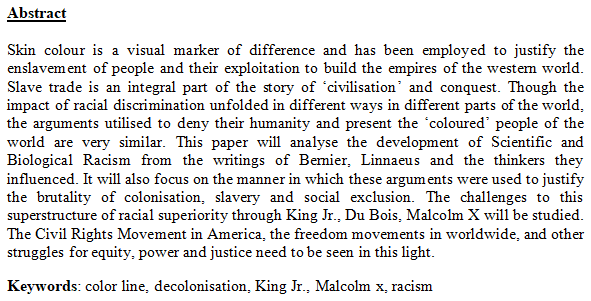
Skin colour is a visual marker of difference and has been employed to justify the enslavement of people and their exploitation to build the empires of the western world. Slave trade is an integral part of the story of ‘civilisation’ and conquest. Though the impact of racial discrimination unfolded in different ways in different parts of the world, the arguments utilised to deny their humanity and present the ‘coloured’ people of the world are very similar. This paper will analyse the development of Scientific and Biological Racism from the writings of Bernier, Linnaeus and the thinkers they influenced. It will also focus on the manner in which these arguments were used to justify the brutality of colonisation, slavery and social exclusion. The challenges to this superstructure of racial superiority through King Jr., Du Bois, Malcolm X will be studied. The Civil Rights Movement in America, the freedom movements in worldwide, and other struggles for equity, power and justice need to be seen in this light.
Downloads
References
Bello, Walden. (2024). The lockean roots of white supremacy in America. Foreign Policy in Focus. https://fpif.org/the-lockean-roots-of-white-supremacy-in-the-u-s/. Accessed 12 Aug. 2024.
Brennan, Tim. (2025). Classification: An overview of selected methodological issues. Crime and Justice, 9, 201–48. http://www.jstor.org/stable/1147393. Accessed 17 May 2025.
Carr, Helen. (2022). The defeat of scientific racism: Charles King, The reinvention of humanity: A story of race, sex, gender and the discovery of culture. Women: A Cultural Review, 33(2), 247–52. https://doi.org/10.1080/09574042.2022.2072616
Charmantier, Isabelle. (2025). Linnaeus and race. The linnean society of London. https://www.linnean.org/learning/who-was-linnaeus/linnaeus-and-race. Accessed 7 July 2025.
Du Bois, W. E. B. (1935). Black reconstruction in America 1860–1880. Harcourt, Brace and Company.
Harris, Kimberley Ann. (2019). ‘W. E. B. Du Bois’ ‘Conservation of Races’: A metaphorical text. Metaphilosophy, 50(5), 670–87. https://doi.org/10.1111/meta.12390
Hörandl, Elvira. (2006). Paraphyletic versus Monophyletic Taxa—Evolutionary versus cladistic classifications. Taxon, 55(3), 564–70. JSTOR. https://doi.org/10.2307/25065631. Accessed 17 May 2025.
Kant, Immanuel. (2007). Anthropology, history, and education. Edited by Robert B. Louden and Gunter Zoller, translated by Mary Gregor, Paul Guyer, Robert B. Louden, et al., Cambridge University Press.
Lectures on Anthropology. (2012). Edited by Allen Wood and Robert Louden. Cambridge University Press.
Largen, Kristin Johnston. (2020). Remembering Martin Luther King, Jr. Dialog, 59(1), 12–13. https://doi.org/10.1111/dial.12541
Locke, John. (1689). Two treatises of government. York University. www.yorku.ca/comninel/courses/3025pdf/Locke.pdf. Accessed 10 Aug. 2024.
Lu-Adler, Huaping. (2022). Kant on lazy savagery, racialized. Journal of the History of Philosophy, 60(2), 253–75. https://doi.org/10.1353/hph.2022.0017. Accessed 9 Aug. 2024.
Malcolm X. (1963). Message to the grassroots. EdChange. http://www.edchange.org/multicultural/speeches/malcolm_x_message.html.
Martin Luther King Jr. (1986). Where do we go from here: Chaos or community?. Beacon Press.
Mills, Charles. (1997). The racial contract. Cornell University Press.
Müller-Wille, Staffan. (2015). Linnaeus and the four corners of the world. The Cultural Politics of Blood, 1500–1900, Edited by Kimberly Anne Coles et al., Palgrave Macmillan, p. 9. https://www.researchgate.net/publication/304862790_Linnaeus_and_the_Four_Corners_of_the_World. Accessed 6 May 2025.
Paradise, Brandon. (2025). Soul force and social transformation: Martin Luther King Jr. beyond liberalism and critical race theory. Journal of Law and Religion, 1–27. Cambridge University Press.
Rabaka, Reiland. (2002). Malcolm X and/as critical theory: Philosophy, radical politics, and the African American search for social justice. Journal of Black Studies, 33(2), 145–65, https://doi.org/10.1177/002193402237222
Richardson, Theresa. (2011). John locke and the myth of race in America: Demythologizing the paradoxes of the enlightenment as visited in the present. Philosophical Studies in Education, 42, 101–12. https://files.eric.ed.gov/fulltext/EJ960330.pdf
Roberts v. (1850). City of Boston, 59 Mass. (5 Cush), p. 198.
Robinson, Dean E., & William W. (1995). Sales. Review of contemporary sociology. Contemporary Sociology, 24(6), 762–64. https://doi.org/10.2307/2076676. Accessed 25 May 2025.
Shaw, S. J. (2022). W. E. B. Du Bois and the evolution of ‘Race. Southern Journal of Philosophy, 60, 73–101. https://doi.org/10.1111/sjp.12479
Stuurman, Siep. (2025). François Bernier and the invention of racial classification. History Workshop Journal, 50, 1–21. http://www.jstor.org/stable/4289688. Accessed 17 May 2025.
Tyner, James A., & R. J. Kruse II. (2004). The geopolitics of Malcolm X. Antipode, 36(1), 24–42https://doi.org/10.1111/j.1467-8330.2004.00380.x
Ward, Julie K., & Tommy L. (2002). Lott, editors. Philosophers on race: Critical essays. Blackwell Publishing.
Worthington, Brian. (2013). Martin Luther King Jr. as identificatory conglomerate. Black Theology, 11(2), 219–39. https://doi.org/10.1179/1476994813Z.0000000004
Published
How to Cite
Issue
Section
License
Copyright (c) 2025 Jyotsna Pathak

This work is licensed under a Creative Commons Attribution 4.0 International License.
Research Articles in 'Social Science Journal for Advanced Research' are Open Access articles published under the Creative Commons CC BY License Creative Commons Attribution 4.0 International License http://creativecommons.org/licenses/by/4.0/. This license allows you to share – copy and redistribute the material in any medium or format. Adapt – remix, transform, and build upon the material for any purpose, even commercially.


